Type: Publication · Research / Historisation Project · Archival Activation
Period: 2018–2021
Location: North Rhine-Westphalia, Germany
Role: Researcher · Oral Historian · Project Collaborator · Educator
Partners: Pina Bausch Foundation · Deutsches Tanzarchiv Köln · Folkwang Tanzarchiv / Folkwang Universität der Künste
Euphorie und Aufbruch — A History of Dance 1959–1969 was a collaborative research and development project involving three dance archives in North Rhine-Westphalia: the Pina Bausch Foundation, the Deutsches Tanzarchiv Köln and the Folkwang Tanzarchiv. The project explored ways of connecting archival collections and making relationships between dispersed materials accessible through a shared digital environment.
The project focused on the period from 1959 to 1969, a formative decade in the development of dance and the artistic environment surrounding Pina Bausch. A selection of archival materials from the participating collections was brought together to create a shared historical view rather than separate institutional narratives.
Archival Activation
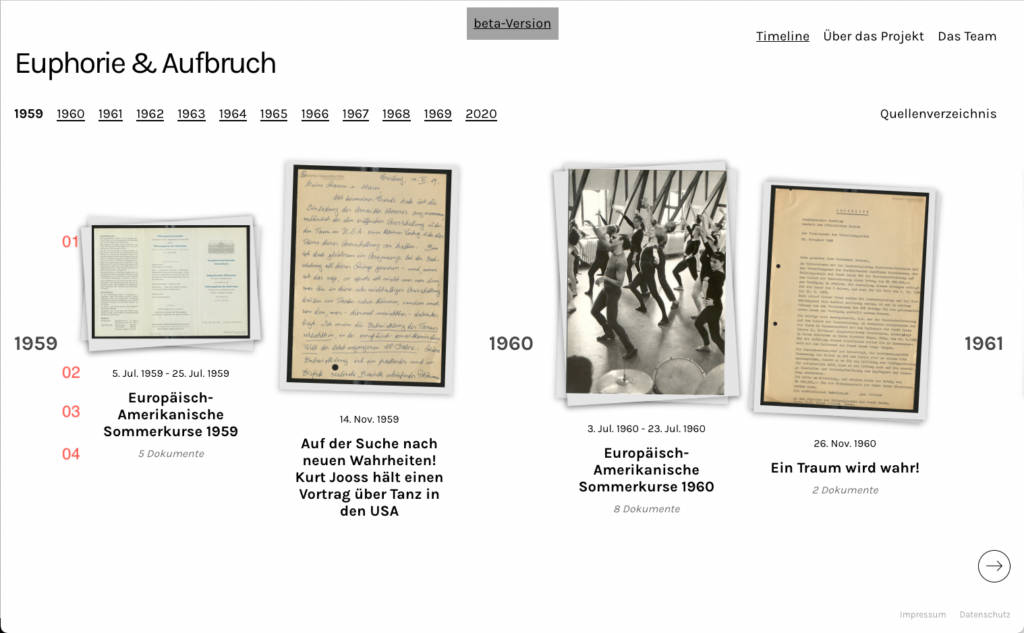
A selection of 99 archival documents — 33 from each participating archive — formed the basis of an interactive chronological timeline. The project made relationships between people, works, events, places and time more visible across the participating collections.
The project also addressed a broader question for dance archives: how can archival structures represent an art form whose primary material is movement, and how can historical relationships become accessible without reducing dance to isolated documents?
Visual Research
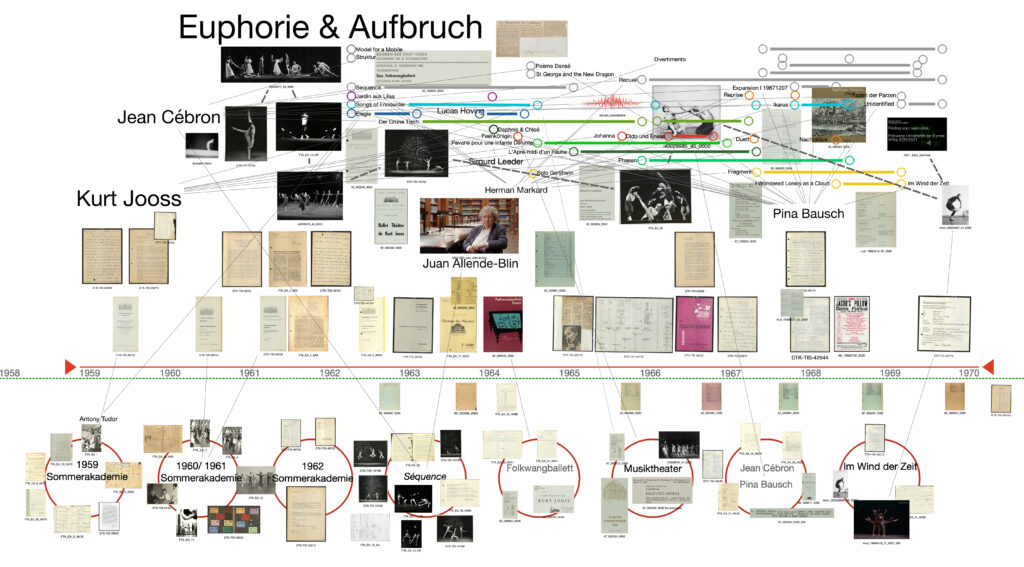
Visual organization of the archival material became an important part of the research. The documents were also approached through comparison and juxtaposition, allowing historical relationships, aesthetic developments and recurring patterns to become visible in ways that complement conventional textual description.
This visual approach treated the archive as a field for observation as well as documentation. It supported attention to the movement and artistic qualities that may be difficult to communicate through text alone.
Oral History
The project also explored digital models for connecting heterogeneous archival information, including CIDOC CRM and FRBRoo. Oral History added another layer to the archival record through an interview with composer Juan Allende-Blin.
The interview connected personal testimony with the documentary record and contributed another perspective on the people, works and circumstances represented in the project.
Finding Your Own Voice
Within the project, Ricardo Viviani taught the semester-long course Finding Your Own Voice at Folkwang Universität der Künste. Students worked with historical photographs and other archival material and used their observations as impulses for contemporary choreographic work.
The course took place remotely during the COVID-19 pandemic. Students submitted their work as video, creating a further context in which archival observation, choreography and the moving image could be brought together.
Archival Material:
Project documentation; timeline material; selected archival documents; visual research; Oral History interview with Juan Allende-Blin; Finding Your Own Voice teaching material; publication material.
Post Scriptum — 30 August 2026
This entry is revisited as part of the continuing documentation of Ricardo Viviani’s work with dance archives, Oral History and archival activation. The project remains a useful case study in bringing collections, historical research, testimony and artistic practice into relation.
Contribution / Ertrag:
The project brought together three dance archives around a shared historical period and created a public digital environment through which their materials could be encountered in relation to one another. Viviani’s contribution included research, Oral History, visual work with archival material and the development of Finding Your Own Voice, through which archival sources became material for contemporary choreographic practice.
Assessment / Relevanz:
The project is relevant as a practical example of collaborative archival work in dance. Its value lies in demonstrating that archival materials can support more than preservation and access: they can also become material for research, interpretation, teaching and artistic practice.
Keywords:
Euphorie und Aufbruch; Dance Archives; Dance History; Oral History; Archival Activation; Archival Research; Dance Heritage; Digital Humanities; Knowledge Technologies; CIDOC CRM; FRBRoo; Visual History; Choreographic Research; Composition; Pina Bausch; Juan Allende-Blin; North Rhine-Westphalia
External Links
Euphorie und Aufbruch — Project Information
Euphorie und Aufbruch — Interactive Timeline
Euphorie und Aufbruch — A History of Dance 1959–1969 — Publication / DOI
Deutsches Tanzarchiv Köln
Internal Links
Sharing the Material is Sharing the Knowledge – Summary in English
Finding Your Own Voice – WS 2020/21
Finding Your Own Voice – Workshop
Archival Note: This page forms part of an ongoing personal archive documenting Ricardo Viviani’s professional work and activities over more than four decades. Names and other personal information appear where relevant to the documented work or collaboration. If you believe that information concerning you has been published incorrectly or should be reconsidered, please contact me.