E55_type of E5_Event by E21_Person presenting E28_Conceptual_Object in a closed F31_Performance experienced by a limited E74_Group
Presential or remote dance teaching
I work with artists, dance companies, universities, archives and cultural institutions, bringing together experience as a dancer and choreographer with many years of research, teaching and Oral History work.
Universities & cultural institutions Lectures, seminars, workshops, research and artistic inquiry
Dance companies & ensembles Mentoring, dramaturgical and artistic consultation, composition and creative processes
Independent choreographers & artists Composition, choreography, mentoring and archival strategies
Type: Press Conference · Video Transcript Summary Date: 23 December 2025 Context: Presentation of the results and future plans of Oral History for Dance Heritage Location: Ukrainian Crisis Media Center, Kyiv, Ukraine Subject: Developing a museum protocol for archiving dance Related Workshop:Oral History for Dance Heritage, 1–6 December 2025
Speakers:
Viktor Ruban
Daryna Yakymova
Ricardo Viviani and representatives of Ukrainian museum and dance institutions, as referred to during the press conference
Press Conference: Oral History for Dance Heritage
This page presents an English summary of the transcript of a publicly available video recording of a press conference held by the Ukrainian Crisis Media Center. The conference presented the results of the Oral History for Dance Heritage project and discussed the next steps following the December 2025 workshop at the National Art Museum of Ukraine (NAMU).
The conference focused particularly on the development of a protocol through which dance could be documented and incorporated into a museum collection. Project curator Viktor Ruban described the work as part of the broader DancePlan Ukraine initiative and as a pilot approach to preserving performative arts through the integration of oral testimony, embodied knowledge and contextual information.
According to Ruban, the protocol responds to the difficulty of preserving dance through conventional museum practices. Dance is not only a performance event but also a social and cultural practice whose histories may disappear when documentation is absent. He emphasized the need to preserve testimonies, archival evidence and research in order to strengthen historical continuity and the visibility of Ukrainian dance.
Daryna Yakymova, curator at NAMU, presented the newly developed three-part protocol for archiving dance:
Metadata — title, authorship, performance history, dance category, format, structure, participants, documentation such as video, photography and audio, and material elements including costumes and props.
Oral History Archive — interviews with performers, choreographers, scenographers, musicians and other contributors, creating a multidisciplinary body of embodied and contextual knowledge.
Reconstruction Protocol — guidelines for preserving essential elements of a dance work, identifying variable components, and documenting rights, licences and technical requirements relevant to future re-performance.
Yakymova explained that museums traditionally work through the preservation of material objects, while dance presents the additional challenge of preserving an ephemeral artistic form. Within the project, Oral History provided a method for extending the museum record beyond physical objects and for incorporating the knowledge and experience of the people who created and performed the work.
The press conference also emphasized the importance of Ricardo Viviani’s experience with Oral History at the Pina Bausch Foundation. His decade of work with dance practitioners was presented as an important reference for adapting Oral History to the Ukrainian context and to the specific requirements of dance heritage.
The speakers described the need for a systematic and accessible structure through which dance could be documented, researched and, where appropriate, reconstructed. In this framework, museum collection, Oral History, archival documentation and future artistic transmission become interconnected rather than separate activities.
The press conference therefore documents a concrete institutional development following the December workshop: the work moved from methodological experimentation toward the formulation of a protocol intended to allow dance to enter a museum collection as a form of cultural heritage.
Archival Material:
Video recording of the press conference; transcript summary; documentation relating to the Oral History for Dance Heritage workshop; material concerning the development of the NAMU dance-archiving protocol.
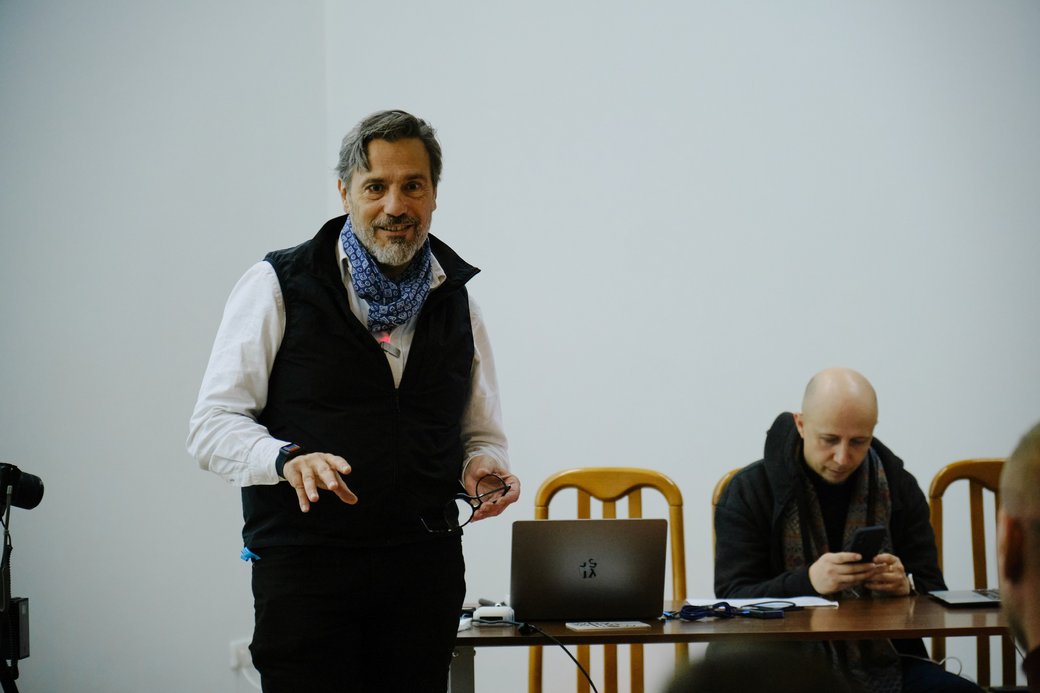
Ricardo Viviani and Viktor Ruban. Photo: Solomiia Kozolup / Suspilne Kultura
Type: Press Report · English Summary Date: 15 December 2025 Context:Oral History for Dance Heritage, National Art Museum of Ukraine (NAMU), Kyiv Author: Maria Kabatsii Publication:Suspilne Kultura Subject: Archiving Ukrainian Dance Heritage
Press Report: How NAMU Works on Archiving Ukrainian Dance
This page presents an English summary of a report by Maria Kabatsii, published by Suspilne Kultura. The journalist attended one day of the six-day intensive Oral History for Dance Heritage at the National Art Museum of Ukraine (NAMU) in Kyiv and its concluding round table. Her report documents how dance researchers, practitioners, museum workers and historians were working to develop approaches to preserving and archiving Ukrainian dance heritage. The report focuses particularly on the adaptation of Oral History to dance and on the institutional challenges involved in bringing an ephemeral art form into museum and archival practice.
The project, Oral History for Dance Heritage, was organized by the Impulse Transformation Platform with support from the Goethe-Institut in Ukraine and in partnership with NAMU. According to the report, Ricardo Viviani was invited as a lecturer and Oral History specialist from the Pina Bausch Foundation, and researchers from different Ukrainian cities worked together with museum specialists to adapt the method to the Ukrainian dance context.
Kabatsii’s report emphasizes the difficulty of documenting dance through conventional verbal or archival means. Viviani describes the challenge as creating ways to talk about dance and to help practitioners express the depth of their knowledge. The article places this question within a wider discussion of the relationship between embodied experience, memory and the documentation of dance.
The report also describes gaps in the documentation of Ukrainian dance. Historian Taras Samchuk points to dance as a comparatively neglected research field, while curator and project initiator Viktor Ruban discusses the loss of experimental dance histories that were not documented and therefore remained primarily in personal memories and private archives. The article connects these gaps with broader questions of cultural memory and identity in Ukraine.
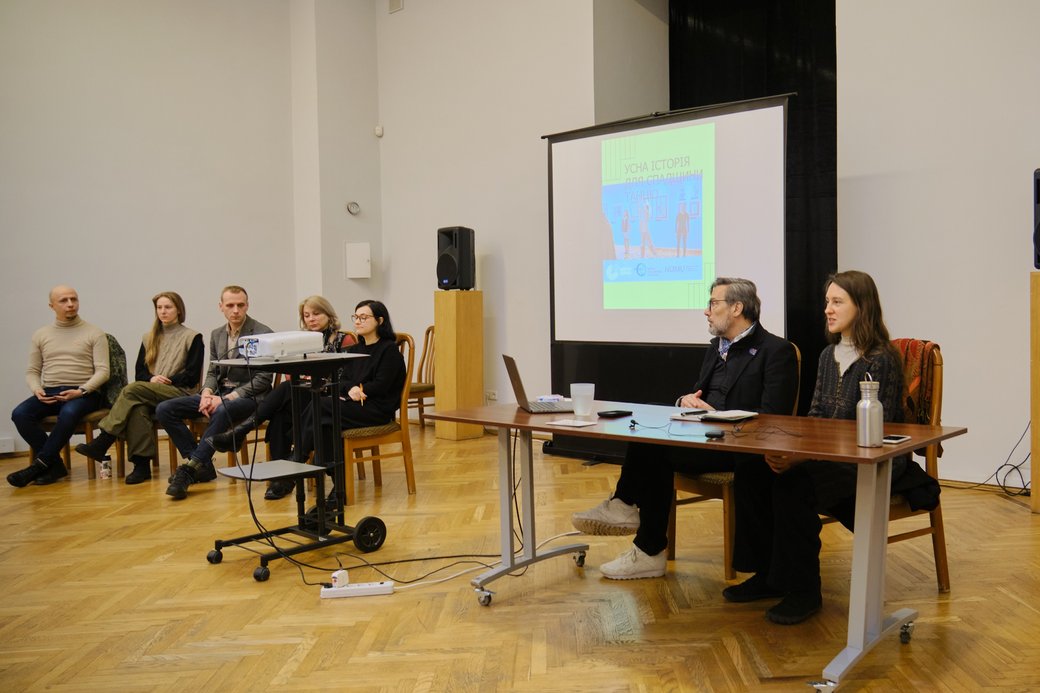
Final round table at NAMU. From left: Viktor Ruban, Khrystyna-Maria Slobodyaniuk, Taras Samchuk, Liudmyla Mova, Daryna Yakymova, Ricardo Viviani and Karina Soika. Photo: Solomiia Kozolup / Suspilne Kultura
The article places the workshop within NAMU’s recent efforts to make dance visible as an artistic medium in its own right. It refers to the museum’s earlier project “Dance in the War Zone?”, which brought contemporary dance into the museum and established a basis for subsequent collaboration between the institution and dance researchers.
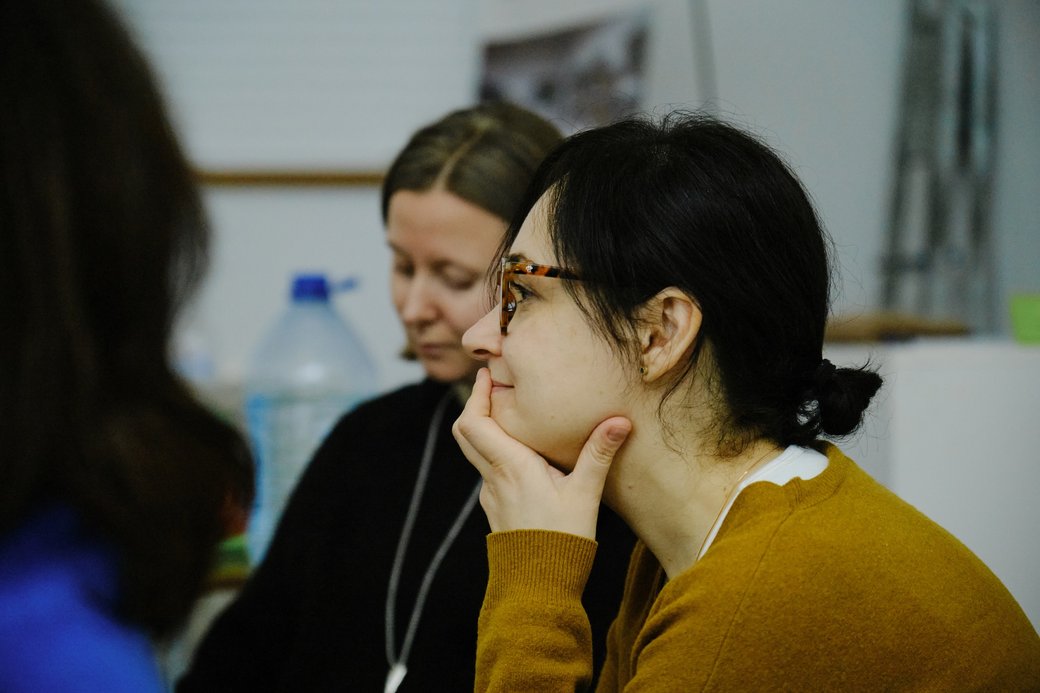
Daryna Yakymova. Photo: Flora Borovyk / Suspilne Kultura
A central point in the report is the development of museum approaches for preserving dance. Daryna Yakymova explains that NAMU intends to develop storage protocols for an ephemeral art form and identifies Oral History as a method that could help document and archive this heritage. She also describes the lack of specialists with specific knowledge of dance history, terminology and archival requirements within museum institutions.
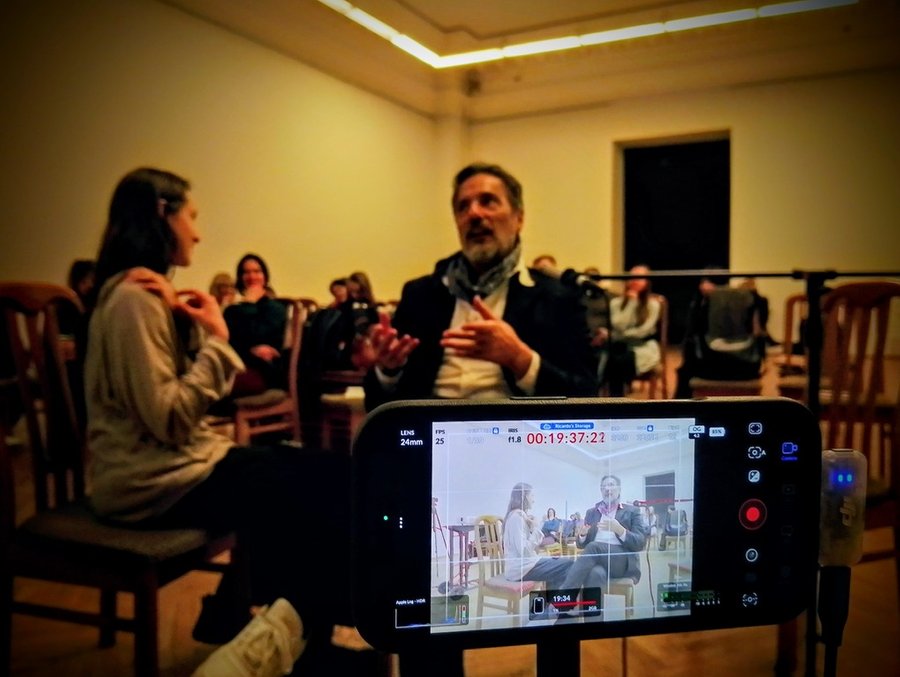
Interview recording training with Ricardo Viviani. Photo: Flora Borovyk / Suspilne Kultura
The report also documents practical interview training during the workshop. Alongside the methodological discussion, participants considered the practical conditions of recording and preserving oral histories and the institutional resources required to maintain a digital archive. Viviani identifies institutional support and digital infrastructure as significant challenges and stresses the need to distinguish the documentation of dance history from the process of creating dance itself.
The article concludes by connecting the preservation of Ukrainian dance with cultural memory and identity. It presents the attempt to archive dance as relevant not only within Ukraine but also internationally, because documenting Ukrainian dance can make histories and practices that remain insufficiently known accessible to wider audiences.
Archival Material:
Press article; press photographs; workshop documentation; interview-training documentation; related project material concerning Oral History for Dance Heritage and the archiving of Ukrainian dance.
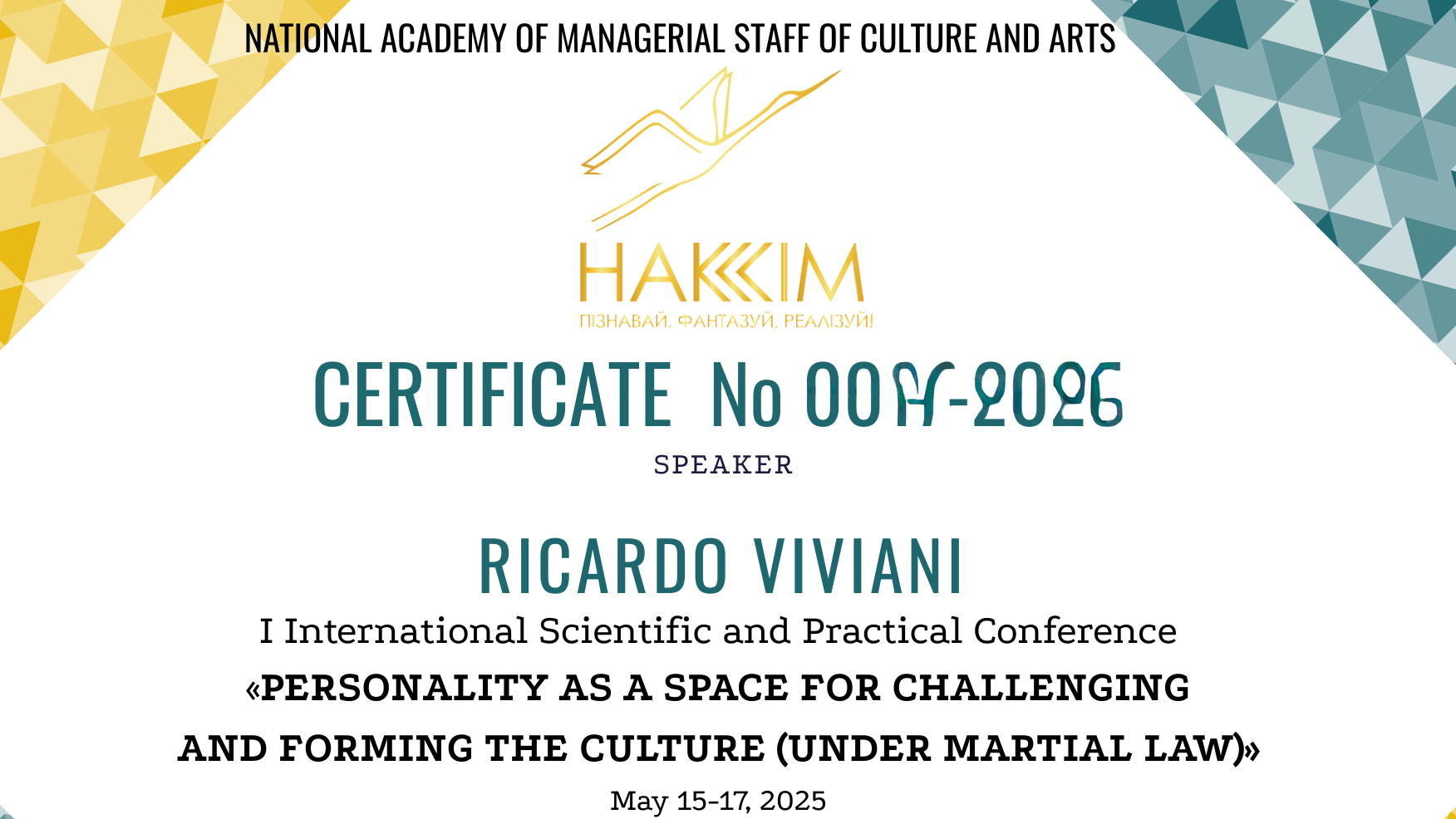
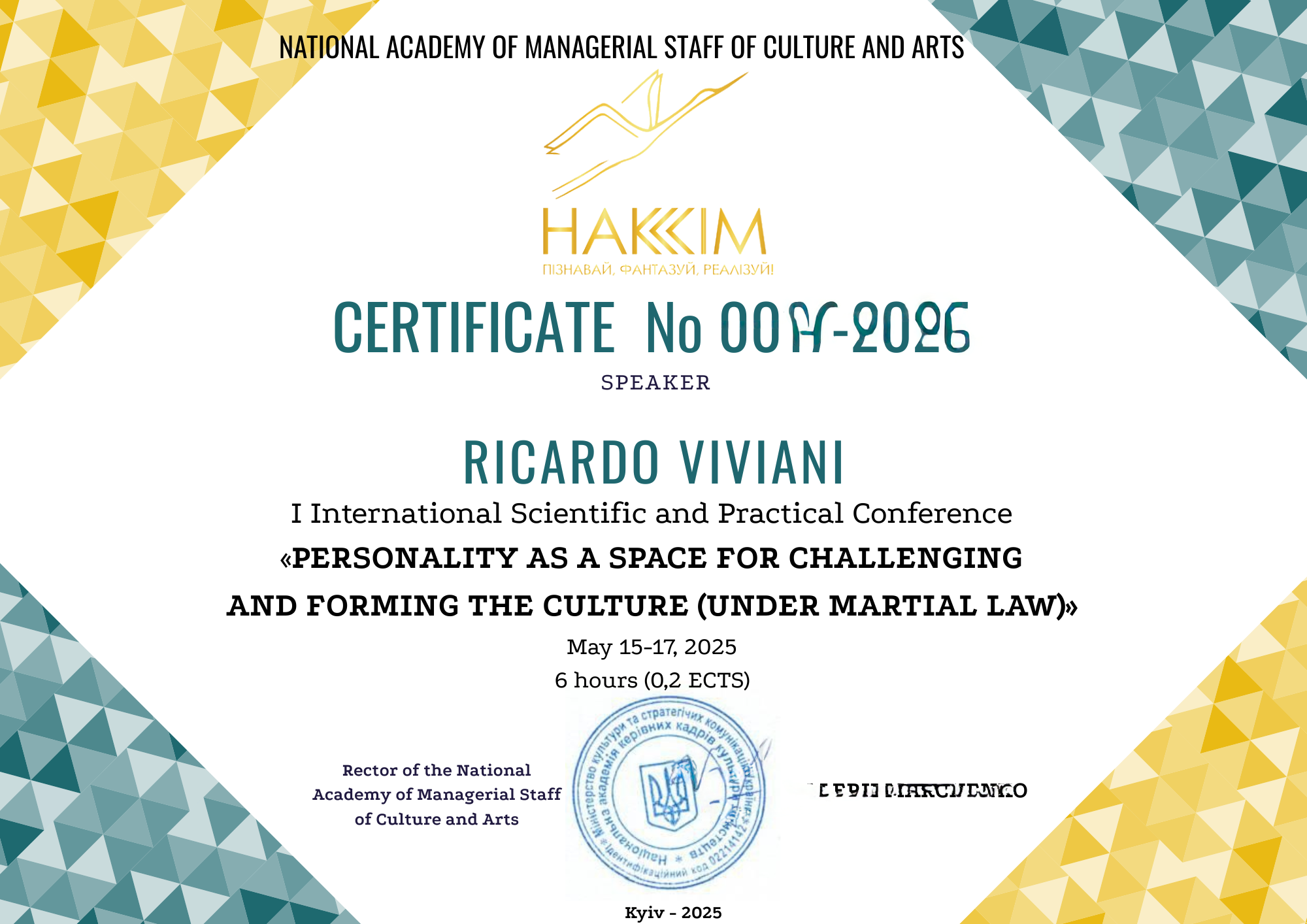
Type: Presentation · Online Contribution Title: The Injustice of Being Silenced Date: 15–17 May 2025 Context: I International Scientific and Practical Conference Personality as a Space for Challenging and Forming the Culture (under Martial Law) Location: National Academy of Managerial Staff of Culture and Arts, Kyiv, Ukraine Organizer: Impulse Transformation Platform Role: Presenter · Researcher
The Injustice of Being Silenced examines the relationship between artistic formation, personal value systems and the social and political environments in which artists come of age. The presentation draws on Ricardo Viviani’s experience both as a dance artist and as an Oral Historian working with life histories of dancers and other practitioners.
The presentation begins from the observation that artistic expression may register aspects of a person’s historical and social experience before those experiences can be fully analyzed or consciously articulated. Dance, theatre, music and performance can therefore provide traces of lived histories that exceed what can later be expressed verbally.
Viviani connects this observation to his own artistic formation during the Brazilian Military Regime (1964–1985), when dance, music and theatre developed forms of expression shaped by political constraint and resistance. The presentation considers comparable situations in other cultural contexts, including Ireland, Germany and the Balkans, where artists worked under political and social pressure.
A central concept is the idea of “anti-biographies”. Viviani uses this term for sequences of events in a person’s biography that become meaningfully contextualized through questioning and the construction of narrative. In this sense, the interview does not simply reproduce a biography already known; it can bring relationships between experience, context and value into articulation. The process has an affinity with oral traditions, in which knowledge is transmitted in forms responsive to the needs and circumstances of the present.
The presentation also considers the relationship between embodied and verbal knowledge. While Oral History is transmitted through the voices of living individuals, artistic works may embody a broader spectrum of lived experience that cannot always be directly articulated in words. Artistic expression can therefore become an additional source through which personal and collective histories may be approached.
The accompanying research notes develop these questions through case studies including Ballet Stagium and the Dzi Croquettes under the Brazilian Military Regime, as well as examples concerning divided Germany, Ireland, the Yugoslav Wars and other situations in which artistic expression developed under political or social duress. These examples examine how cultural agents developed forms, vocabularies and practices capable of expressing experiences that could not always be stated directly.
The presentation connects these observations to Viviani’s broader practice as a choreographer and Oral Historian. His personal history is not treated only as biographical information, but also as part of the perspective through which research questions are formed and artistic expression is understood.
Archival Material:
Conference abstract; presentation notes; presentation material; related research and bibliographic notes; documentation of the online contribution.
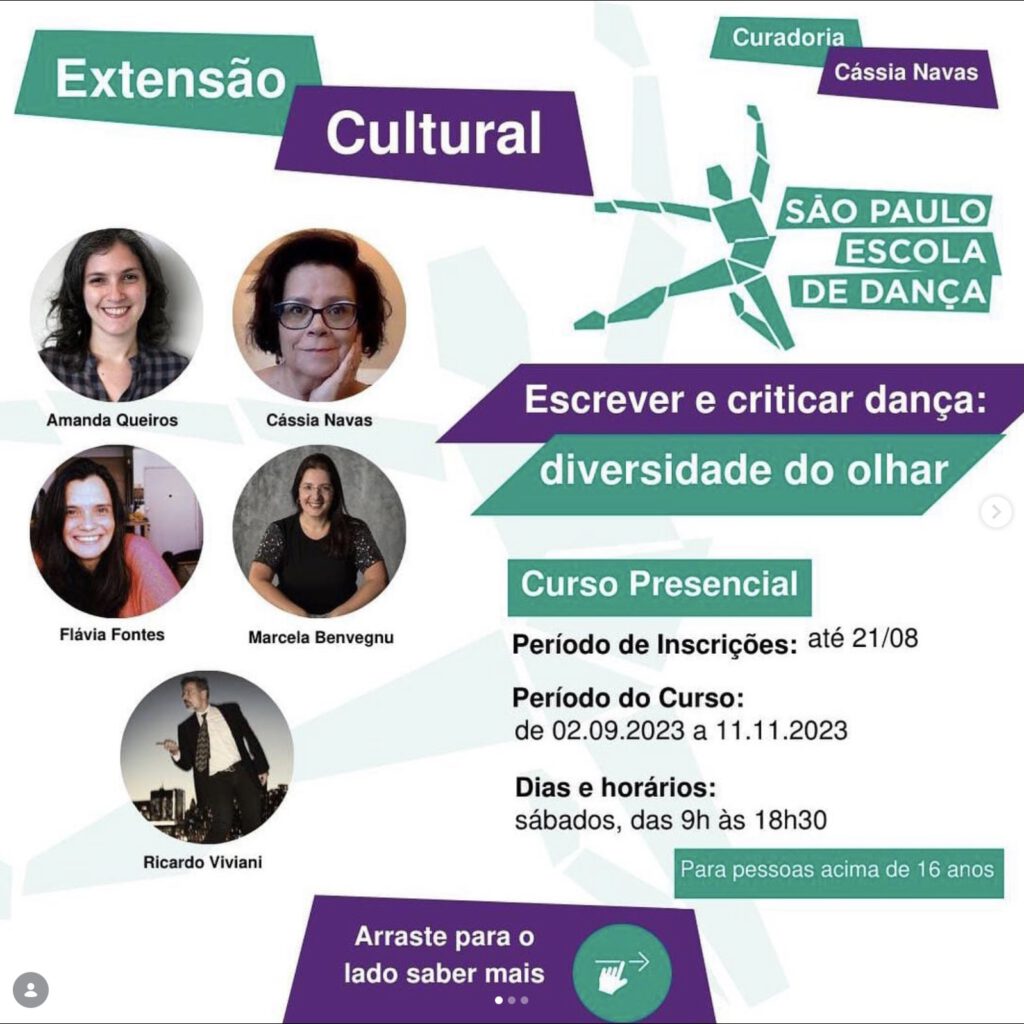
Diversidade Do Olhar – estou muito feliz em colaborar com a São Paulo Escola de Dança. Minha contribuição é em explorar as formas de como usamos palavras na dança: a oralidade na dança.
Esse módulo é para todas as pessoas que comunicam dança: criadores, equipes e multiplicadores.
a dança dispensa palavras? sim. a dança, o ato de dançar, e a recepção da dança são processos que independem da palavra. a palavra falada, cantada ou escrita são elementos que podem ou não acompanhar a dança. o processo de criação, passa por decisões pensadas. a comunicação com outros artistas envolvidos na criação usa quase que inevitavelmente palavras, comunicação oral. a transmissão da experiência de dançar, apreciar a dança também se beneficia das ferramenta culturais que são a oralidade e a escrita. quais palavras pensadas, faladas ou escritas são essas? desde instruções como um simples ‘vamos formar um círculo’, às descrições de sentimentos, impulsos através de imagens e estórias, a oralidade faz parte do nosso imaginário. nesse módulo presencial vamos conectar a experiência visceral da dança com as várias modalidades de comunicar na fala e escrita. vamos explorar e aguçar de forma sistemática as capacidades sensoriais da experiência, dentro do visual, auditivo, táctil e pesquisar formas de criar elos entre esse fugidio e temporal para palavras. a intenção é criar pontes de percepção e expandir o vocabulário. um diferencial dentro do universo dançado brasileiro é a possibilidade de incorporar o imaginário mágico e espiritual na análise.
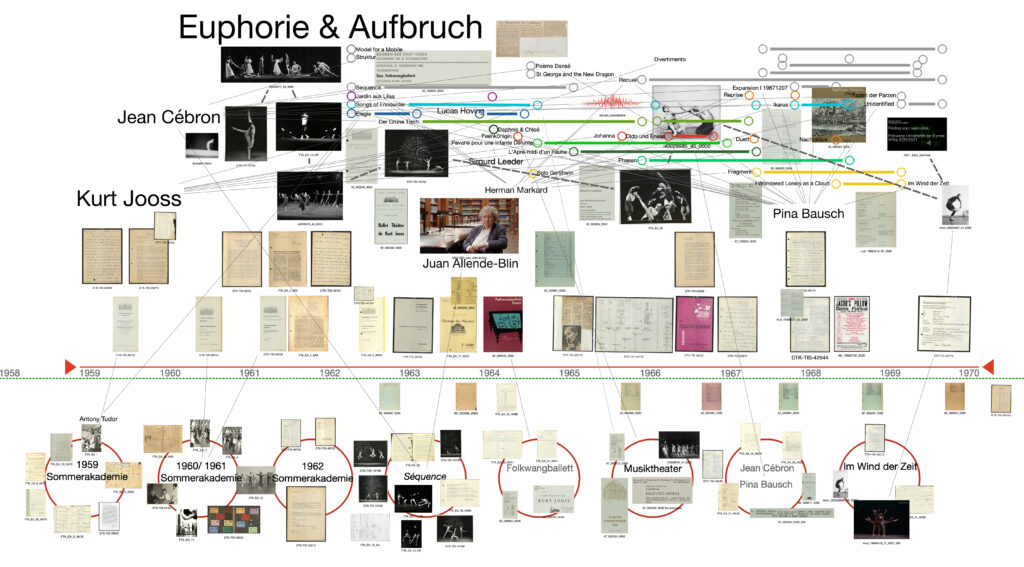
Euphorie und Aufbruch Timeline — Sorting and grouping of 99 Documents (Viviani 2020)
Type: Publication · Research / Historisation Project Date: September 2022 Context:Tanzen/Teilen – Sharing/Dancing: Jahrbuch TanzForschung 2021 Role: Ricardo Viviani – Author · Researcher · Project Collaborator Co-authors: Anja K. Arend · Thomas Thorausch Project:Euphorie und Aufbruch — A History of Dance 1959–1969 Publisher: transcript Verlag
Sharing the Material is Sharing the Knowledge / Tanzwissen teilen im Verbund documents an experimental approach to sharing and connecting dance-archival material across institutional collections. The chapter emerged from the research project Euphorie und Aufbruch, a collaboration between the Pina Bausch Foundation, the Deutsches Tanzarchiv Köln and the Folkwang Tanzarchiv / Folkwang Universität der Künste.
The chapter begins from a basic problem of dance heritage: an archive cannot contain the whole of dance. What survives is always partial, shaped by the histories of collection, preservation, description and institutional selection. The project therefore explored what might become visible when material from different archives is brought into relation rather than presented as separate institutional holdings.
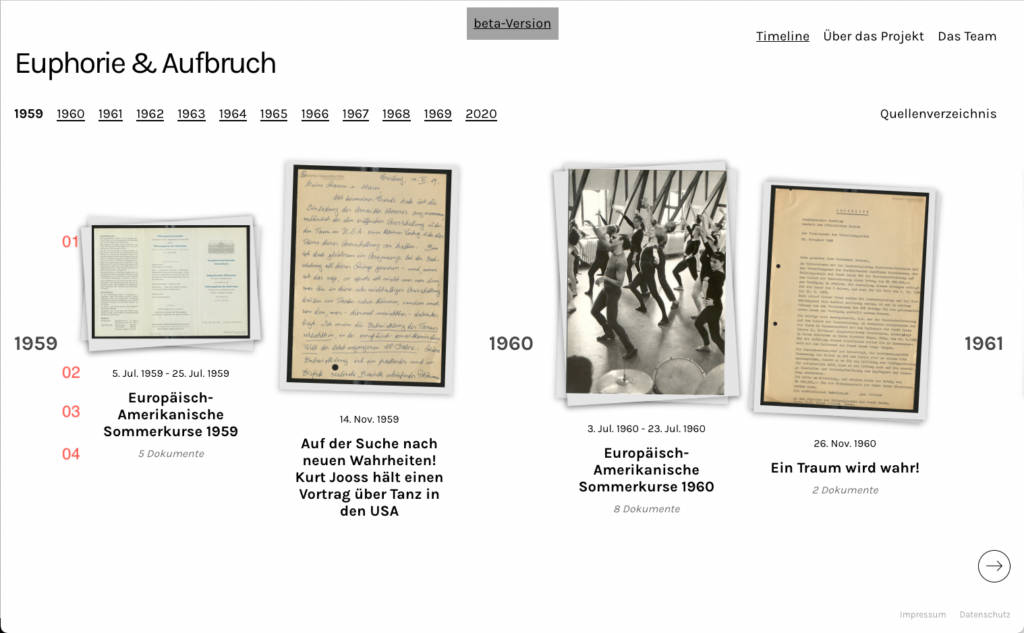
For the pilot project, a selection of 99 archival documents from the three participating collections was organized around relationships between people, works, events, places and time. The resulting digital environment used a chronological timeline as a principal point of access, while also making connections between heterogeneous materials more visible.
The chapter considers archival knowledge as something that can emerge through relationships among documents, people, works and historical circumstances. In this perspective, sharing material between institutions can also become a way of sharing knowledge and making previously separated holdings meaningful in relation to one another.
A central question concerns the particular demands of dance archives. Dance is not exhausted by the documents that record it: movement, practice, embodied knowledge and changing relationships are difficult to represent through conventional archival description alone. The project therefore explored conceptual models including CIDOC CRM and FRBRoo as possible structures for relating heterogeneous information across collections.
Oral History provided another layer of connection. Ricardo Viviani’s interview with composer Juan Allende-Blin brought personal testimony and experience into dialogue with archival records. Within the project, Oral History provided a perspective through which documentary material could be connected with lived historical experience.
The wider project also included an educational strand documented through Finding Your Own Voice. Historical photographs and other archival materials were used as impulses for observation, analysis and choreographic work. Students transformed observations from archival material into concepts and choreographic assignments, bringing archival research into a contemporary artistic context.
Taken together, the chapter presents the archive as an interconnected knowledge environment rather than as a collection of isolated objects. Its concern is not simply how to preserve material, but how relationships between collections, documents, people and experience can make different forms of historical knowledge accessible.
Archival Material:
Published German chapter; project documentation; visual research materials; timeline documentation; selection of 99 archival documents; Oral History interview with Juan Allende-Blin; Finding Your Own Voice teaching materials; related research notes.
Type: Publication · Research / Historisation Project · Archival Activation Period: 2018–2021 Location: North Rhine-Westphalia, Germany Role: Researcher · Oral Historian · Project Collaborator · Educator Partners: Pina Bausch Foundation · Deutsches Tanzarchiv Köln · Folkwang Tanzarchiv / Folkwang Universität der Künste
Euphorie und Aufbruch — A History of Dance 1959–1969 was a collaborative research and development project involving three dance archives in North Rhine-Westphalia: the Pina Bausch Foundation, the Deutsches Tanzarchiv Köln and the Folkwang Tanzarchiv. The project explored ways of connecting archival collections and making relationships between dispersed materials accessible through a shared digital environment.
The project focused on the period from 1959 to 1969, a formative decade in the development of dance and the artistic environment surrounding Pina Bausch. A selection of archival materials from the participating collections was brought together to create a shared historical view rather than separate institutional narratives.
Archival Activation
A selection of 99 archival documents — 33 from each participating archive — formed the basis of an interactive chronological timeline. The project made relationships between people, works, events, places and time more visible across the participating collections.
The project also addressed a broader question for dance archives: how can archival structures represent an art form whose primary material is movement, and how can historical relationships become accessible without reducing dance to isolated documents?
Visual Research
Euphorie und Aufbruch Timeline — Sorting and grouping of 99 Documents (Viviani 2020)
Visual organization of the archival material became an important part of the research. The documents were also approached through comparison and juxtaposition, allowing historical relationships, aesthetic developments and recurring patterns to become visible in ways that complement conventional textual description.
This visual approach treated the archive as a field for observation as well as documentation. It supported attention to the movement and artistic qualities that may be difficult to communicate through text alone.
Oral History
The project also explored digital models for connecting heterogeneous archival information, including CIDOC CRM and FRBRoo. Oral History added another layer to the archival record through an interview with composer Juan Allende-Blin.
The interview connected personal testimony with the documentary record and contributed another perspective on the people, works and circumstances represented in the project.
Finding Your Own Voice
Within the project, Ricardo Viviani taught the semester-long course Finding Your Own Voice at Folkwang Universität der Künste. Students worked with historical photographs and other archival material and used their observations as impulses for contemporary choreographic work.
The course took place remotely during the COVID-19 pandemic. Students submitted their work as video, creating a further context in which archival observation, choreography and the moving image could be brought together.
Archival Material:
Project documentation; timeline material; selected archival documents; visual research; Oral History interview with Juan Allende-Blin; Finding Your Own Voice teaching material; publication material.
In this workshop, the professional choreographer and oral-historian Ricardo Viviani together with Sarah Walker, a fellow oral-historian will explore in which ways the awareness of non-verbal communication elements influence the outcome of an interview.
We are always communicating with our bodies. From postures to the placement of the body in space, these elements are constantly sending messages. By being aware of which non-verbal elements are important to observe, the interviewer can help the narrator feel more comfortable. A narrator that feels comfortable with the situation is freer to talk.
Of great importance are also the signals sent by the interviewer during an interview. Appropriate clothing that respects and eases the power structures at play during an interview, postures, gestures, help to engage the narrator. The body of the interviewer is just as important as the body of the narrator.
The analysis of video interviews can also benefit from the knowledge of non-verbals. Spoken language can acquire different colors and weights according to the complex interplay of non-verbals. Most oral-historians can adjust transcripts accordingly. This workshop will help to describe how these non-verbals are at play during the interview, thus helping to articulate the reasons for adjustments.
The workshop will consist of a theoretical introduction, examples that will be played out by the workshop leaders, followed by simulating situations and analyzing them. A group exchange of experiences will round-up this session.