Type: Publication · Research / Historisation Project
Date: September 2022
Context: Tanzen/Teilen – Sharing/Dancing: Jahrbuch TanzForschung 2021
Role: Ricardo Viviani – Author · Researcher · Project Collaborator
Co-authors: Anja K. Arend · Thomas Thorausch
Project: Euphorie und Aufbruch — A History of Dance 1959–1969
Publisher: transcript Verlag
Sharing the Material is Sharing the Knowledge / Tanzwissen teilen im Verbund documents an experimental approach to sharing and connecting dance-archival material across institutional collections. The chapter emerged from the research project Euphorie und Aufbruch, a collaboration between the Pina Bausch Foundation, the Deutsches Tanzarchiv Köln and the Folkwang Tanzarchiv / Folkwang Universität der Künste.
The chapter begins from a basic problem of dance heritage: an archive cannot contain the whole of dance. What survives is always partial, shaped by the histories of collection, preservation, description and institutional selection. The project therefore explored what might become visible when material from different archives is brought into relation rather than presented as separate institutional holdings.
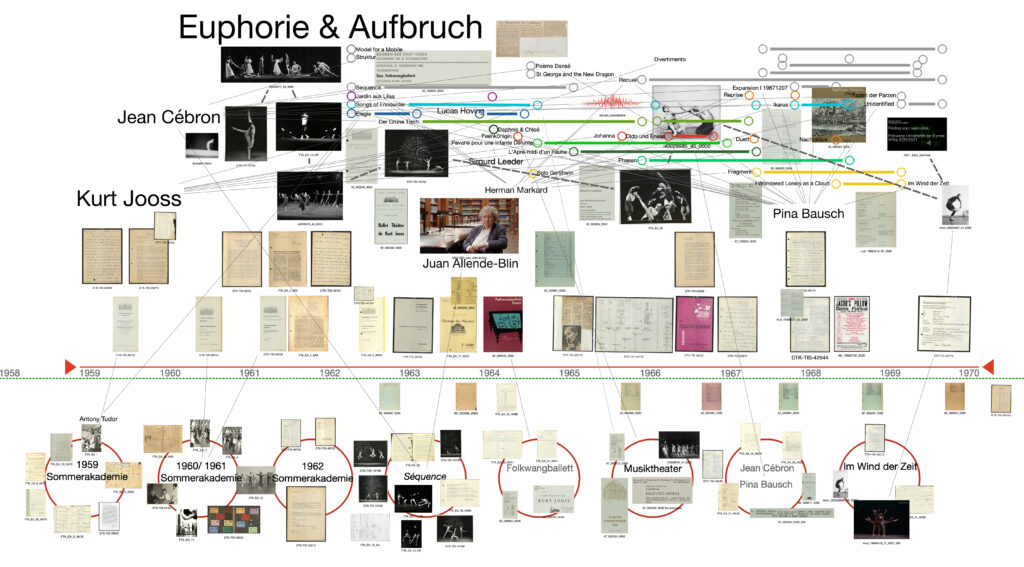
For the pilot project, a selection of 99 archival documents from the three participating collections was organized around relationships between people, works, events, places and time. The resulting digital environment used a chronological timeline as a principal point of access, while also making connections between heterogeneous materials more visible.
The chapter considers archival knowledge as something that can emerge through relationships among documents, people, works and historical circumstances. In this perspective, sharing material between institutions can also become a way of sharing knowledge and making previously separated holdings meaningful in relation to one another.
A central question concerns the particular demands of dance archives. Dance is not exhausted by the documents that record it: movement, practice, embodied knowledge and changing relationships are difficult to represent through conventional archival description alone. The project therefore explored conceptual models including CIDOC CRM and FRBRoo as possible structures for relating heterogeneous information across collections.
Oral History provided another layer of connection. Ricardo Viviani’s interview with composer Juan Allende-Blin brought personal testimony and experience into dialogue with archival records. Within the project, Oral History provided a perspective through which documentary material could be connected with lived historical experience.
The wider project also included an educational strand documented through Finding Your Own Voice. Historical photographs and other archival materials were used as impulses for observation, analysis and choreographic work. Students transformed observations from archival material into concepts and choreographic assignments, bringing archival research into a contemporary artistic context.
Taken together, the chapter presents the archive as an interconnected knowledge environment rather than as a collection of isolated objects. Its concern is not simply how to preserve material, but how relationships between collections, documents, people and experience can make different forms of historical knowledge accessible.
Archival Material:
Published German chapter; project documentation; visual research materials; timeline documentation; selection of 99 archival documents; Oral History interview with Juan Allende-Blin; Finding Your Own Voice teaching materials; related research notes.
Post Scriptum — 30 August 2026
This page provides an English-language summary of the published German chapter, of which Ricardo Viviani is a co-author. It is an independent summary and synthesis for readers who may not work in German; it is not a translation or reproduction of the published text.
The publication is revisited here in relation to the continuing development of work with dance archives, Oral History and the activation of archival knowledge.
Contribution / Ertrag:
The chapter documents a practical attempt to connect distributed dance-archive collections and to make relationships between heterogeneous materials more visible. It brings together archival collaboration, digital structuring, Oral History and education within the framework of Euphorie und Aufbruch.
Assessment / Relevanz:
The publication is relevant as a record of collaborative research into how dance archives can communicate across institutional boundaries. Its particular value lies in showing that access to archival knowledge depends not only on digitization or preservation, but also on the relationships established between collections, documents, people and historical experience.
Keywords:
Dance Archives; Dance History; Oral History; Archival Research; Archival Activation; Knowledge Technologies; CIDOC CRM; FRBRoo; Dance Heritage; Visual History; Institutional Collaboration; Choreographic Research; Pina Bausch; Juan Allende-Blin; Euphorie und Aufbruch
External Links
Sharing the Material is Sharing the Knowledge — Chapter DOI
Tanzen/Teilen – Sharing/Dancing — Book DOI
Euphorie und Aufbruch — Project Information
Euphorie und Aufbruch — Interactive Timeline
Internal Links
Euphorie und Aufbruch — A History of Dance 1959–1969
Finding Your Own Voice — WS 2020/21
Finding Your Own Voice — Workshop
Common Dance, Uncommon Stories — Public Archive Entry
[im]materiality — The Whole Life: Archives and Reality
Archival Note: This page forms part of an ongoing personal archive documenting Ricardo Viviani’s professional work and activities over more than four decades. Names and other personal information appear where relevant to the documented work or collaboration. If you believe that information concerning you has been published incorrectly or should be reconsidered, please contact me.