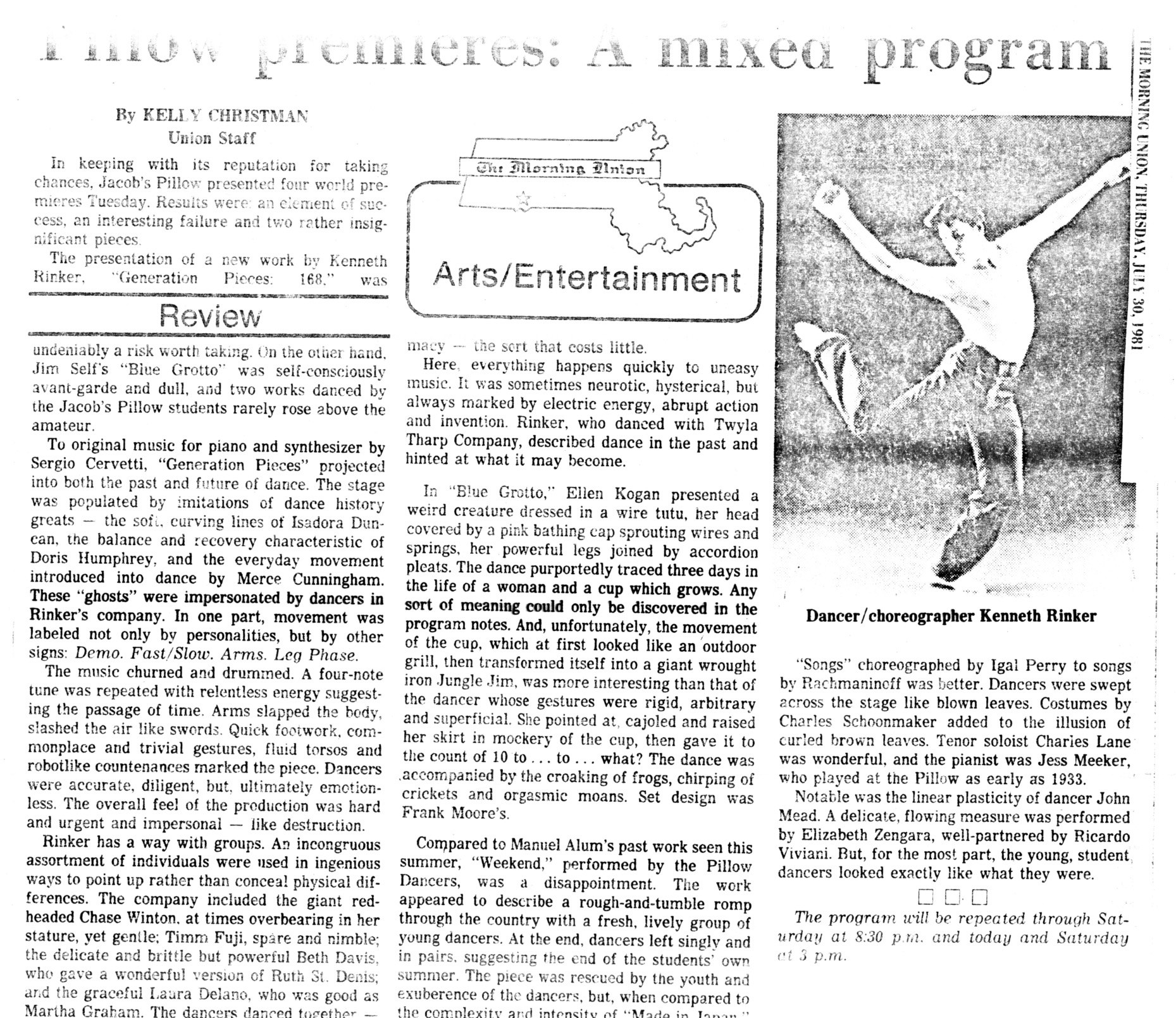
…”Mr. Perry moves his 12 dancers about the tiny space impressively, giving them big jumps – crisply executed -and runs for a note of urgency.” Jennifer Dunning
…”A delicate, flowing measure was peformed by Elizabeth Zengara, well-partnered by Ricardo Viviani”
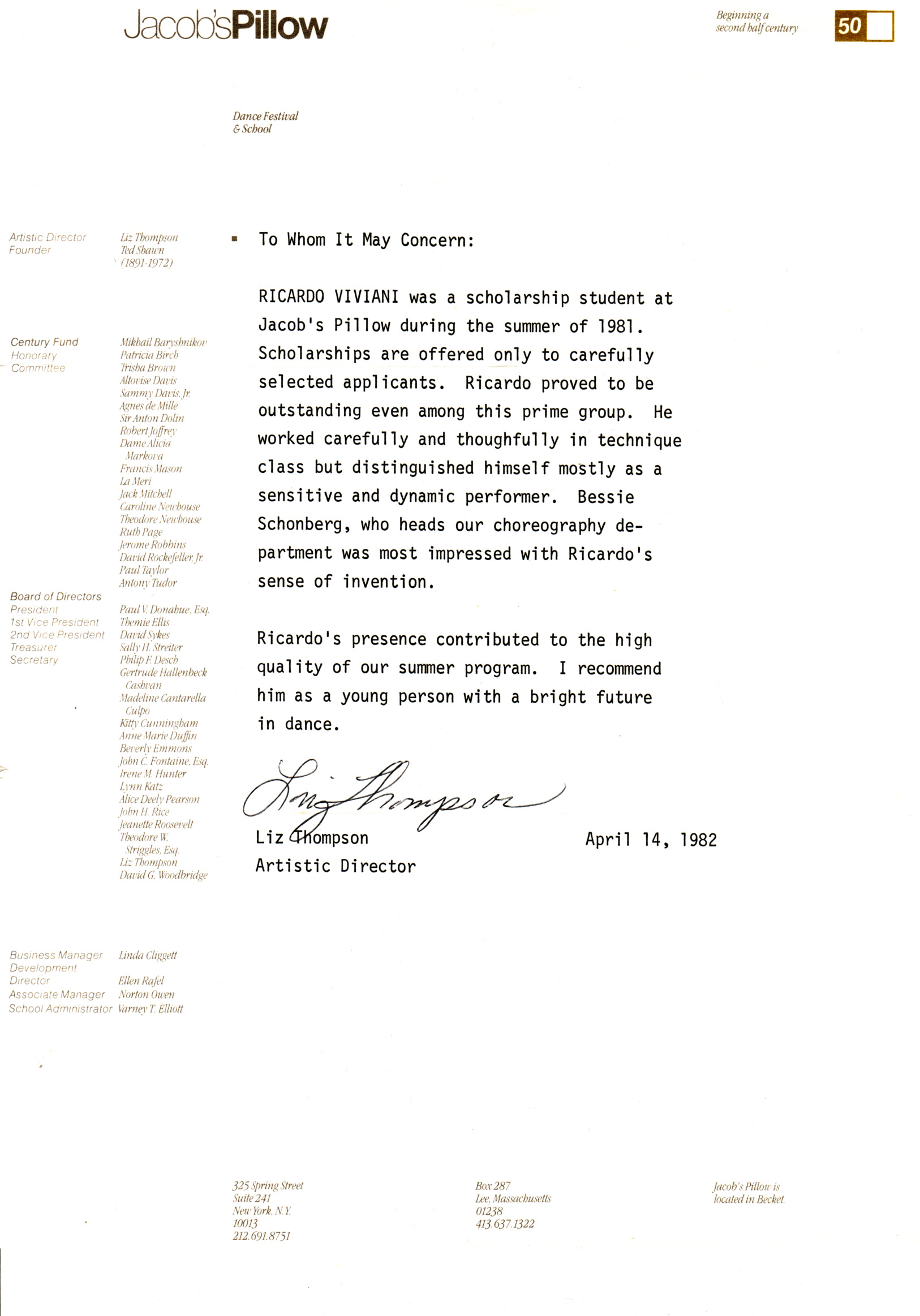
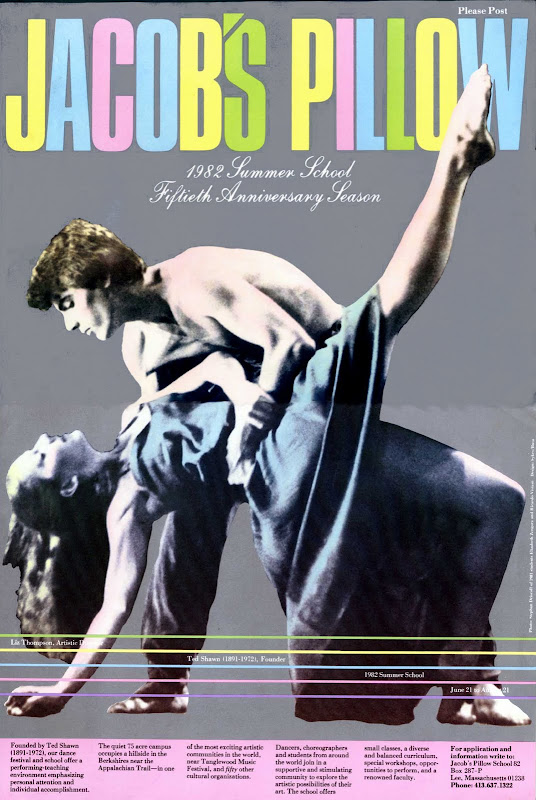
Jacob’s Pillow is a very special place. The school is a summer camp; the students live in cabins scattered around the woods of the Berkshire Mountains. The program includes an intensive dance education with 5 dance classes per day. The scholarship program also includes work on the many skills needed for running a dance performance: this way the students are also involved in the performances presented at the Dance Festival.
“The Pillow” first introduced me to Bessie Schönberg, Liz Thompson, Manuel Alum, Bill Irwin, the Kathakali Dance of India and so many other people.
”Bessie Schönberg, who heads our choreography department was most impressed with Ricardo’s sense of invention.”
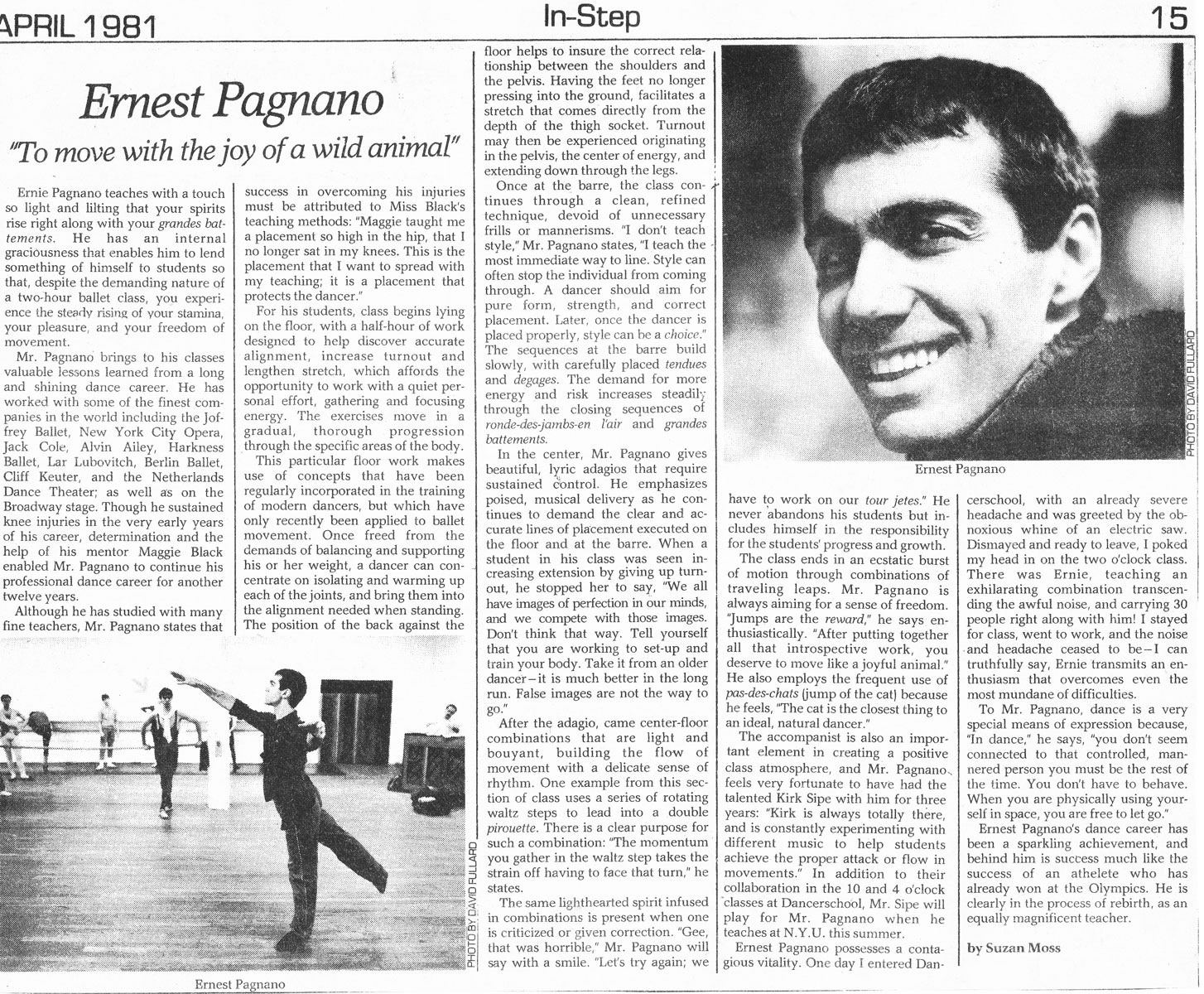
Ernie Pagnano teaches with a touch so light and lifting that your spirits rise right along with your grandes battements. He has an internal graciousness that enables him to lend something of himself to students so that, despite the demanding nature of a two-hour ballet class, you experience the steady rising of your stamina, your pleasure, and your freedom of movement.
Mr. Pagnano brings to his classes valuable lessons learned from a long and shining dance career. He has worked with some of the finest companies in the world including the Joffrey Ballet, New York City Opera, Jack Cole, Alvin Ailey, Harkness Ballet, Lar Lubovitch, Berlin Ballet, Cliff Keuter, and the Netherlands Dance Theater-, as well as on tile Broadway stage. Though he sustained knee injuries in the very early years of his career, determination and the help of his mentor Maggie Black enabled Mr. Pagnano to continue his professional dance career for another twelve years.
Although he has studied with many fine teachers, Mr. Pagnano states that success in overcoming his injuries must be attributed to Miss Black’s teaching methods: “Maggie taught me a placement so high in the hip, that I no longer sat in my knees. This is the placement that I want to spread with my teaching; it is a placement that protects the dancer.”
Ernie Pagnano, died in 1987.
Did you take classes with Ernie? Tell us about your experience.
Type: Dance Work / Piece · Class / Teaching Date: 6 February 1981 – 24 April 1981 Time-span: February–April 1981 Context: Scholarship study / work-study programme in dance training Location: 400 Lafayette Street, New York, USA Institution / Organisation: DANCERSCHOOL — Dennis Wayne, Artistic Director Role: Dancer · Student Participants: Dennis Wayne; Alyce Katayama; Ernie Pagnano; Marcus Schulkind; other teachers and students — further names to be reconstructed Status: Historical Record — incomplete / ongoing archival reconstruction
DANCERSCHOOL This page documents Ricardo Viviani’s scholarship study at DANCERSCHOOL, located at 400 Lafayette Street in New York City, from 6 February to 24 April 1981. The scholarship combined full-time dance study with daily work duties and became an important period in Viviani’s artistic formation and subsequent international trajectory.
The Work / Creation
This record does not document a choreographic work but a period of intensive dance training. DANCERSCHOOL provided Ricardo Viviani with a scholarship that enabled him to study dance full-time in New York while contributing daily work duties to the school.
In later reflection, Viviani has described the experience as particularly enriching because of its variety of teachers, the intensity of the daily schedule and the opportunity to encounter different approaches to dance training within one environment.
Production
Not applicable as a production record. This entry documents an educational and artistic formation period rather than a staged production.
Performance History
Not applicable as a performance record. The significance of this entry lies in the daily training and work-study structure rather than in a specific performance.
Primary Source / Documentation
Format: Correspondence / Recommendation Letter / Verification Letter / Press Clipping Provenance: Ricardo Viviani Personal Archive Status: Original / Archival scan / Documentary source
A letter dated 24 April 1981, signed by Alyce Katayama on behalf of Dennis Wayne, verifies that Ricardo Viviani was a full-time scholarship student at DANCERSCHOOL from 6 February 1981 to 24 April 1981. The letter states that he attended dance classes daily and also performed daily work duties.
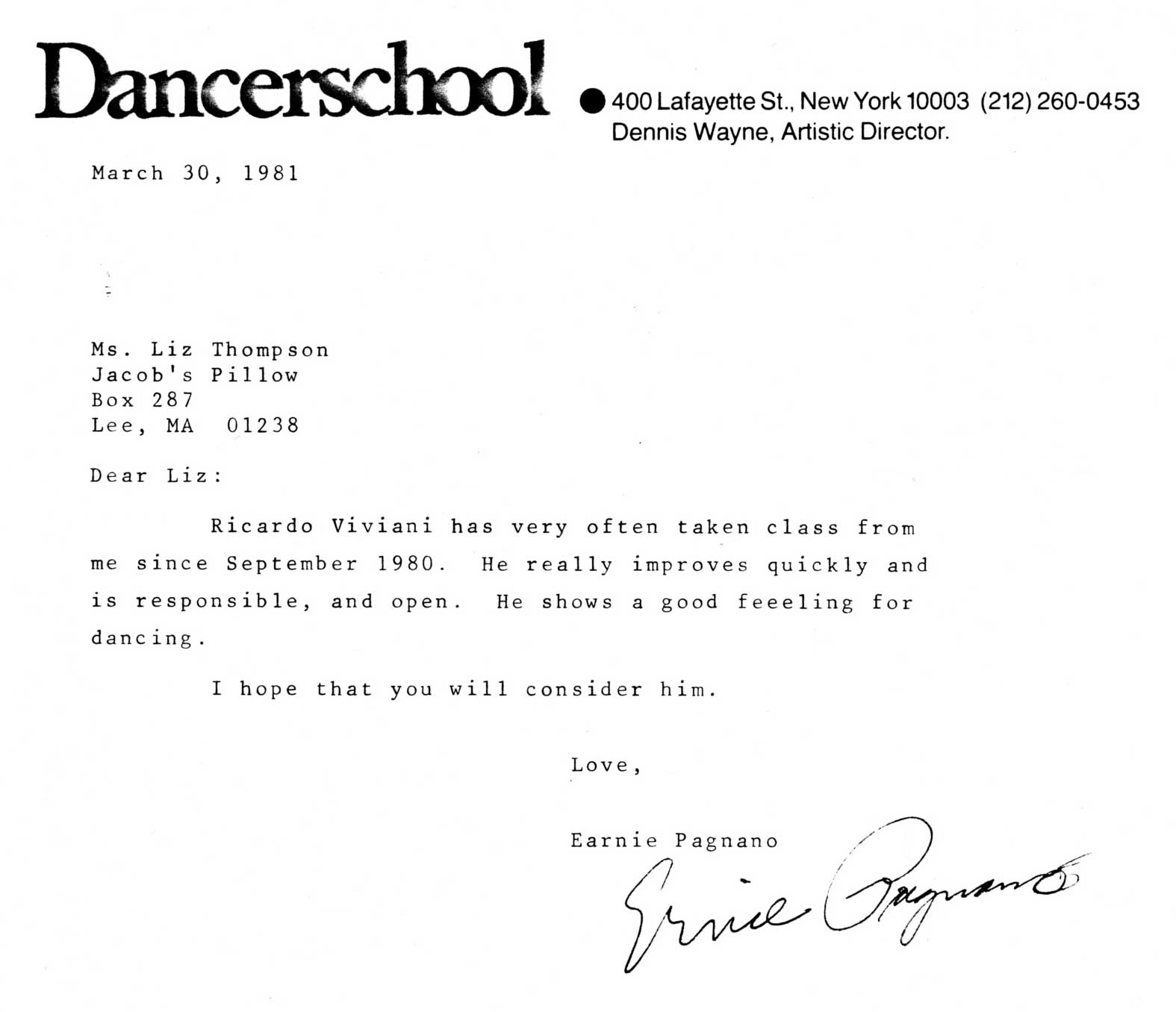
A recommendation dated 30 March 1981 from DANCERSCHOOL, addressed to Liz Thompson at Jacob’s Pillow, states that Viviani had been taking class with Dennis Wayne since September 1980 and describes him as responsible, open and responsive to correction.
A further recommendation dated 13 March 1981 identifies Viviani as a scholarship student at DANCERSCHOOL and describes him as a talented and dedicated young man who worked consistently in class and was dependable and responsible in his scholarship duties.
Research
The surviving documents establish the scholarship period and the combination of daily dance classes with daily work duties. Further research may establish the complete teaching faculty, the structure of the scholarship programme, the history of the DANCERSCHOOL premises at 400 Lafayette Street, and the relationship between the school and other New York dance institutions and programmes.
Personal Reflection
Ricardo Viviani remembers the scholarship as a work-study arrangement. He recalls arriving early in the morning, from approximately 7:00 to 9:00, to carry out cleaning and maintenance duties before taking dance classes throughout the day. He remembers cleaning the mirrors and floors of the newly renovated studio at 400 Lafayette Street, which he recalls as approximately 400 square metres.
This description of the daily routine is preserved as personal recollection. The surviving April 1981 letter independently confirms the existence of daily work duties but does not specify the hours, the precise cleaning tasks or the dimensions of the studio.
Viviani remembers the training as a varied and very enriching experience. Among the teachers who became particularly important to him was Ernie Pagnano. He also remembers other teachers whose names will be added to this record progressively as they are recalled and, where possible, documented.
The later significance of the school’s name and motto also remained with Viviani. The memory of DANCERSCHOOL and its simple identification with “Dancers” became a point of reflection many years later in his presentation Just Call Us Dancers.
Relationship
The relationship with Ernie Pagnano became particularly significant within Viviani’s training at DANCERSCHOOL. Pagnano’s teaching remained an important reference in Viviani’s memory of his New York formation.
Viviani’s later archive record on Pagnano describes his teaching approach and identifies the importance Viviani attributes to him as a teacher. The relationship should be understood as part of the broader network of teachers and artistic encounters that shaped this period of training.
Place / Context
DANCERSCHOOL was located at 400 Lafayette Street in New York City. Viviani remembers the studio as newly renovated at the time of his scholarship and recalls its large studio space as an important physical environment for his daily training.
The address also places this period within the wider New York dance environment in which Viviani was studying, taking classes and developing professional relationships. The experience became a foundation for subsequent opportunities, including his connection with Jacob’s Pillow.
Archival Material
Archival Material:
DANCERSCHOOL scholarship verification letter, 24 April 1981, signed by Alyce Katayama for Dennis Wayne, DANCERSCHOOL; DANCERSCHOOL recommendation letter, 30 March 1981, to Liz Thompson at Jacob’s Pillow; DANCERSCHOOL scholarship recommendation, 13 March 1981; In-Step, April 1981, article on Ernie Pagnano; Dance Magazine, June 1981, article on Musawwir and Toby Towson; In-Step, May 1981, article on Marcus Schulkind; further DANCERSCHOOL material to be identified and added
Cast – Três Ensaios (e o resto) – Bienal de São Paulo 1979
Type: Dance Work / Piece · Production Date: 1979 Context: Dance production presented in the context of the 15th Bienal de São Paulo Location: São Paulo, Brazil Institution / Organisation: Bienal de São Paulo Role: Performer Participants: Sônia Mota — choreographer; Marco Antonio Carvalho — stage and musical director; Grupo Andança — performers Status: Historical Record — documented
Record / Description
Três Ensaios (e o resto) was a dance production created for Grupo Andança and presented in São Paulo in 1979 in the context of the 15th Bienal de São Paulo. Historical and scholarly documentation identifies Sônia Mota as choreographer and places the work’s premiere on 6 November 1979 at the Pavilhão do Parque Ibirapuera. The surviving programme identifies Marco Antonio Carvalho as responsible for stage direction and musical direction and identifies Ricardo Viviani among the performers of Grupo Andança.
The Work / Creation
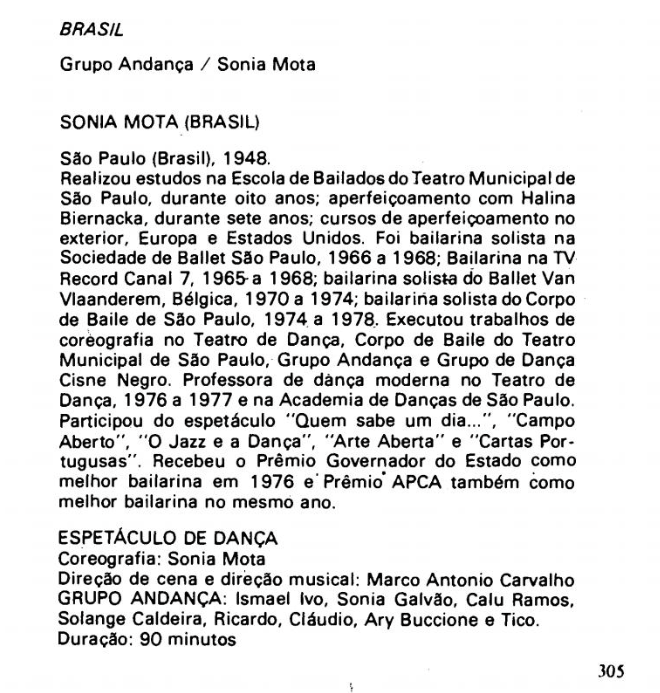
Três Ensaios (e o resto) was choreographed by Sônia Mota for Grupo Andança. The surviving programme identifies the production as a dance spectacle with a duration of approximately 90 minutes. It also identifies Marco Antonio Carvalho as responsible for stage direction and musical direction.
Screenshot Page 305 – Bienal de São Paulo 1979
Creative Team
Choreography: Sônia Mota Stage Direction: Marco Antonio Carvalho Musical Direction: Marco Antonio Carvalho Music: Keith Jarrett — The Köln Concert Duration: 90 minutes
Performers / Collaborators
Grupo Andança: Ismael Ivo, Sônia Galvão, Calu Ramos, Solange Caldeira, Ricardo, Cláudio, Ary Buccione and Tico.
The surviving programme identifies Ricardo by first name within the listed Grupo Andança cast. The full programme should be retained as the primary source for this identification and for future clarification of the complete names of performers currently listed only by first name.
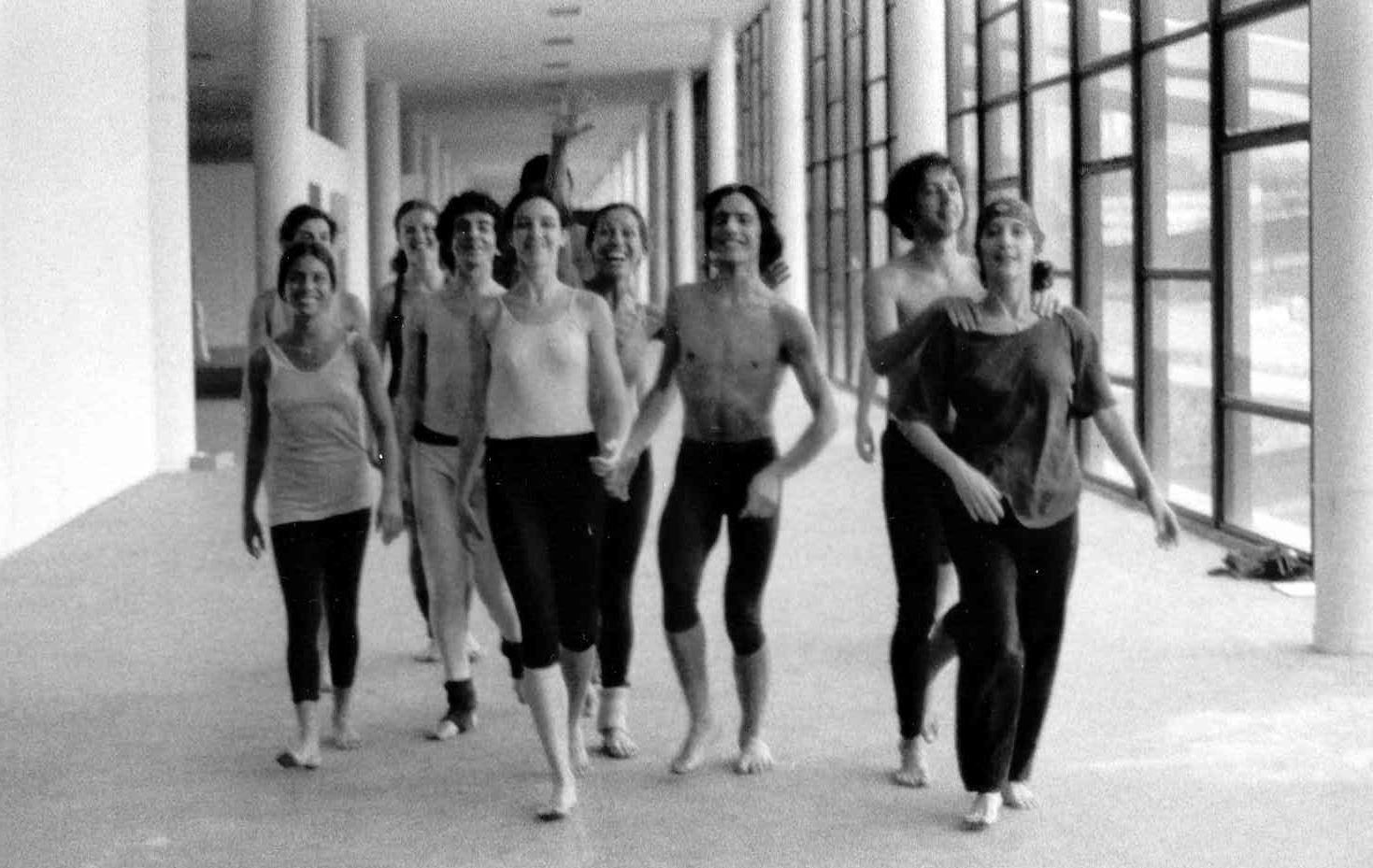
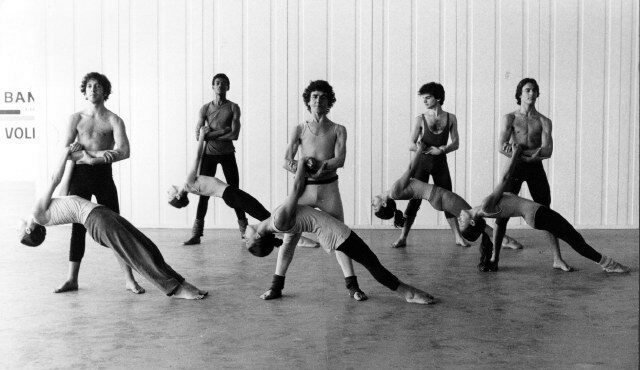
Group – Três Ensaios (e o resto) – Bienal de São Paulo 1979
Performance / Presentation
6 November 1979 — XV Bienal de São Paulo
Pavilhão do Parque Ibirapuera
São Paulo, Brazil
Historical documentation identifies 6 November 1979 as the premiere of Três Ensaios (e o resto) at the XV Bienal de São Paulo, in the Pavilhão do Parque Ibirapuera.
Artistic Context
Três Ensaios (e o resto) belongs to the contemporary dance environment of São Paulo in the late 1970s and to the professional activity of Grupo Andança. The production was choreographed by Sônia Mota and presented a group of performers including Ismael Ivo and Ricardo Viviani.
The production was presented in the context of the 15th Bienal de São Paulo, held from 3 October to 16 December 1979. The official Bienal documentation describes the 15th Bienal as the “Bienal das Bienais”, providing a broad historical and international context for the event.
Relationship / Professional Collaboration
This production documents an early professional collaboration between Ricardo Viviani and Sônia Mota, who is identified in the surviving programme as the choreographer of Três Ensaios (e o resto).
The programme also documents Ismael Ivo as a member of Grupo Andança in the production. Ricardo Viviani’s later professional collaboration with Ivo should be treated as a distinct subsequent relationship.
Viviani’s first professional collaboration with Ismael Ivo dates from 1996, when he joined the Deutsches Nationaltheater Weimar as a dancer in Ivo’s company. This later period represents a substantial continuation of the professional relationship documented here, but should not be conflated with the 1979 production.
In 2003, Viviani began choreographing for opera productions at the Deutsches Nationaltheater Weimar. This represents a further development of his professional practice, moving from his earlier work as a dancer in Ivo’s company into choreography for opera.
Primary Source / Documentation
The principal surviving documentary evidence currently available for this record is the original programme. The programme identifies Sônia Mota as choreographer, Marco Antonio Carvalho as responsible for stage and musical direction, the Grupo Andança performers, and the production duration of 90 minutes. It also provides biographical information about Sônia Mota and documents her professional activity in Brazil and abroad.
Additional scholarly documentation is provided by Sílvia Maria Geraldi’s Raízes da teatralidade na dança cênica: recortes de uma tendência paulistana, a doctoral study at the Universidade Estadual de Campinas documenting and reconstructing the production of Sônia Mota and Célia Gouvêa during the 1970s and 1980s. The research brings together historical documents, photographs, press material and interviews and is therefore particularly relevant to the reconstruction of this period.
The programme is particularly significant because it provides direct contemporary evidence for the production credits and cast. It should therefore take precedence over earlier assumptions concerning individual participation or roles.
Archival Material
1979 — Original programme for Três Ensaios (e o resto), including production credits, cast and biographical information on Sônia Mota 1979 — Photographs of the production / performance 2009 — Sílvia Maria Geraldi, Raízes da teatralidade na dança cênica: recortes de uma tendência paulistana, doctoral thesis, Universidade Estadual de Campinas
Contribution / Significance
Três Ensaios (e o resto) documents an early point in Ricardo Viviani’s professional trajectory and a significant early collaboration with Sônia Mota. The surviving programme also places Viviani within Grupo Andança alongside Ismael Ivo and other dancers active in São Paulo’s contemporary dance environment in 1979.
The work is also significant within the longer professional network documented elsewhere in this archive, connecting early São Paulo collaborations with later work involving Sônia Mota, Ismael Ivo and other artists and institutions.
Assessment / Relevance
The original programme substantially strengthens the documentary status of this record by providing contemporary evidence for the choreographer, direction, musical direction, cast and duration of the production. Additional historical research provides further evidence for the work’s title, premiere date and venue and places the production within the wider development of São Paulo contemporary dance in the period.
Keywords
Três Ensaios (e o resto), Sônia Mota, Ismael Ivo, Grupo Andança, Ricardo Viviani, Marco Antonio Carvalho, Keith Jarrett, The Köln Concert, Bienal de São Paulo, 15th Bienal, contemporary dance, São Paulo, dance, choreography, 1979
Archival Note: This page forms part of an ongoing personal archive documenting Ricardo Viviani’s professional work and activities over more than four decades. Names and other personal information appear where relevant to the documented work or collaboration. If you believe that information concerning you has been published incorrectly or should be reconsidered, please contact me.
Type: Person / Artistic Relationship Date: 1978 — first encounter Time-span: 7 April 1930 – 8 January 1988 Place of birth: Berlin, Germany Place of death: Feira de Santana, Bahia, Brazil Context: Artistic and pedagogical influence Relationship: Pedagogical Influence · Artistic Lineage First documented presentation: 11 May 2015 Related record: Rolf Gelewski — Presentation / Research
Rolf Gelewski
Rolf Gelewski (7 April 1930 – 8 January 1988) was a dancer and pedagogue whose work became an important influence on Ricardo Viviani’s understanding of dance creation and the ways in which creative impulses can be approached through movement.
Viviani encountered Gelewski in 1978. This encounter belongs to the early formation of his own artistic and pedagogical understanding and became part of a longer lineage that he returned to many years later.
Gelewski’s teaching became particularly relevant to Viviani’s thinking about creative impulse, movement and the observation of dance creation. The relationship is therefore preserved here as a person record rather than only as a reference within a later presentation.
This page is intended as a developing record. Biographical information, personal recollections, archival references and further material may be added as sources are reviewed.
1978 — First Encounter
The year 1978 marks the first encounter between Ricardo Viviani and Rolf Gelewski. It is used here as the temporal anchor for the relationship represented by this page.
The page does not attempt to reconstruct that encounter beyond what can presently be documented. Further recollection may be added separately as personal archival material.
Pedagogical Lineage
Gelewski’s work belongs to a lineage of modern dance pedagogy connected to Mary Wigman and Rudolf von Laban. His pedagogical practice in Brazil became an important reference for Viviani’s later interest in the creative process and in ways of approaching dance through movement rather than movement description alone.
2015 Research
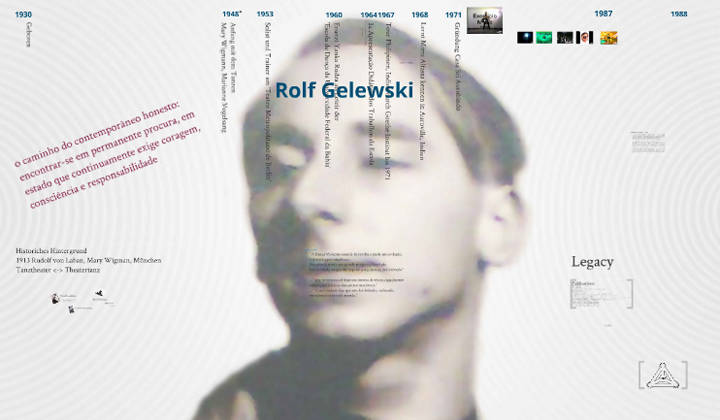
In 2015, Viviani returned to Gelewski as a subject of research and prepared a Prezi presentation devoted to his biography and pedagogical legacy. That presentation is preserved as a separate archival record.
Archival Material:
Biographical research; 2015 Prezi presentation; presentation images; research notes; subsequent references to Gelewski.
…”Mr. Perry moves his 12 dancers about the tiny space impressively, giving them big jumps – crisply executed -and runs for a note of urgency.” Jennifer Dunning
…”A delicate, flowing measure was peformed by Elizabeth Zengara, well-partnered by Ricardo Viviani”
”Bessie Schönberg, who heads our choreography department was most impressed with Ricardo’s sense of invention.”