
Just Call Us Dancers

Just Call Us Dancers — Oral History in the Performing Arts
Just Call Us Dancers — presentation material

Type: Presentation · Oral History
Date: 17 October 2019
Context: Oral History Association Annual Meeting, Pathways in the Field: Considerations for those Working In, On, and Around Oral History
Location: Sheraton Salt Lake City Hotel, Salt Lake City, Utah, USA
Panel: Oral History in Artistic Mediums
Role: Presenter · Researcher
Affiliation: FernUniversität in Hagen

Panel Participants:
Ricardo Viviani
Kenneth Horowitz
Daniel Horowitz Garcia


In the winter of 1980/81, I was awarded a scholarship to study at a dance studio located at 400 Lafayette Street in New York City. The name of this studio was Dancerschool. The studio was part of the life work of Dennis Wayne, a star dancer of the 1970s. His company was called “Dancers”, just the word “Dancers”. The simplicity of that name indicates that what they do should suffice.
The art speaks for itself. 

The title Just Call Us Dancers comes from this memory. It is therefore both a reference to that particular moment in my own formation and a question about what can be communicated by the practice itself, before it is translated into explanatory language.

Just Call Us DancersOral History in the Performing Arts was a presentation about Ricardo Viviani’s pathway from dance and choreography into Oral History and about the methodological questions that arise when oral history is applied to a predominantly non-verbal art form.

The presentation was deliberately personal. Using slides that included images from Viviani’s early years as a dancer, it traced a path that began with his unexpected discovery of dance while studying Biology at the University of São Paulo. During university strikes, he encountered a dance group forming in the Faculty of Architecture (FAU). The group, composed of amateur dancers, chose the deliberately grand institutional name Corpos de Baile. What began as a moment of curiosity became a professional artistic trajectory.

A year or two later, Viviani entered the Escola de Comunicações e Artes — Escola de Arte Dramática (ECA-EAD) at the University of São Paulo to study Theatre Direction, as a dance programme was not available there in 1979. His teachers directed his attention toward non-verbal communication, giving him a way of thinking about performance beyond spoken language.

This formation took place during the Brazilian Military Regime. Viviani observed how music, theatre and dance could contain several layers of meaning and how artists developed forms capable of communicating around censorship. Learning to create and read these layers of meaning became useful to him as a choreographer and remained part of his artistic practice.

The presentation then followed the longer development of this interest: from early choreography and a continuing attention to non-verbal communication, through years of artistic practice and further study, to Viviani’s later decision to investigate these questions more systematically.

Alongside his work as a choreographer, Viviani returned to formal study through Cultural Sciences (Kulturwissenschaften) at FernUniversität in Hagen. He regarded this as continuing education rather than a break from his artistic practice. Through these studies he encountered Oral History and recognized a methodological correspondence with questions he had carried through his artistic life: how can knowledge embedded in lived practice be investigated, articulated and placed within a historical context?

The presentation argued that dancers can be unusually difficult interview subjects because dance contains forms of knowledge that are not primarily verbal. Studio communication can be pragmatic, affective, metaphorical and inseparable from movement. The challenge for the interviewer is therefore not simply to ask dancers to explain what they know, but to create conditions in which aspects of their experience can become narratable.

A related question concerned the role from which knowledge is acquired. In an institutional dance environment, dancers experience creative processes according to their position within the theatre structure. Their memories therefore contain not only individual recollection, but knowledge shaped by their particular role, relationships and responsibilities.

The presentation also introduced the idea that apparently simple biographical questions can open onto much wider historical contexts. A question such as “How did you start to dance?” may begin as a personal biography and lead toward histories of education, cultural identity, political circumstances and artistic formation. The interview becomes a space in which these unexpected connections can emerge.

One example from Viviani’s Oral History work concerns a dancer’s account of learning ballet in Dublin during the 1970s. What begins as a question about entering dance opens onto questions of cultural identity and the experience of studying ballet within a context shaped by the colonial relationship between Ireland and the United Kingdom. Such moments demonstrate how the apparent simplicity of a life-history question can reveal wider historical structures.

The presentation therefore positioned Oral History not simply as a means of collecting memories, but as a form of inquiry in which the specific knowledge of the interviewer and the artistic field can help open questions that might otherwise remain inaccessible.

Archival Material:
Presentation slides; presentation PDF; conference programme; research notes; related Oral History interview material; documentation of subsequent work on non-verbal communication in interviewing.


Continue reading “Just Call Us Dancers”
Common Dance, Uncommon Stories

2019 conference submission for Common Dance, Uncommon Stories
Conference submission — Common Dance, Uncommon Stories, Dance Studies Association Conference 2019

Type: Presentation · Individual Paper
Date: 9 August 2019
Context: Dance Studies Association Conference Dancing in Common
Location: Evanston, Illinois, USA
Role: Presenter · Researcher
Affiliation: FernUniversität in Hagen, Germany


Common Dance, Uncommon Stories — Oral History epistemology for dance explored how Oral History might be approached within the particular conditions of dance practice and a dance artist’s archive.

The presentation considered how people involved in dance may hold different experiences of the same work, and how these experiences can become part of its historical record. It focused on the relationship between embodied knowledge, oral narration and memory, with particular attention to the roles people occupy within theatrical dance.

The idea of the “paradoxical body” provided one point of departure: the body transformed through choreography carries traces of experience that may not be fully accessible through conventional documentation.

The presentation also considered the specific character of speaking about dance. Language in and around the studio can be pragmatic, affective or metaphorical, and can remain closely connected to movement and context. The interview was therefore approached as a situation in which dance experience can become a historical narrative.

Time and memory formed another part of the inquiry. The experience of a dance event and the later moment of the interview are not the same. The presentation considered how these different temporal positions shape the narratives through which dance is remembered.

One common dance generates many uncommon stories.

Archival Material:
Conference submission; presentation slides; presentation script; conference proceedings; research notes.


Continue reading “Common Dance, Uncommon Stories”

[im]materiality

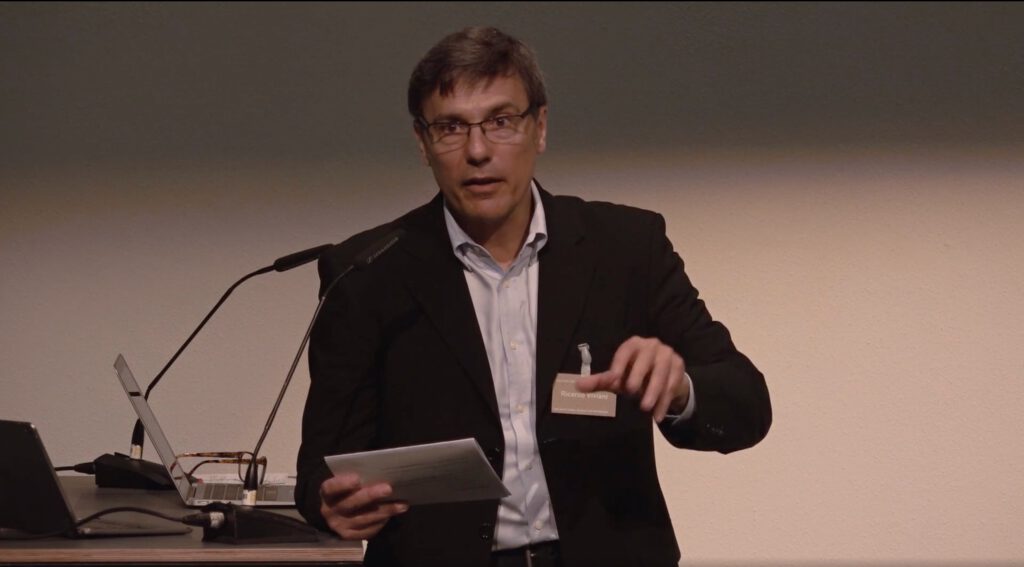
Ricardo Viviani speaking in a podium
Screenshot https://mediathek.hkw.de/video/-im-materialitaet-des-archivs–deutsch–englisch-

Type: Presentation / Performance / Conversation
Date: 25 May 2019
Context: The Whole Life: Archives and Reality, Haus der Kulturen der Welt, Berlin
Institution: Pina Bausch Foundation
Role: Presenter / Researcher

Participants:
Barbara Kaufmann
Azusa Seyama
Marc Wagenbach
Ismaël Dia
Ricardo Viviani


[im]materiality explored the difficulty of documenting and transmitting dance, an art form whose primary expression is ephemeral and performative. Presented by the Pina Bausch Archives within the congress The Whole Life: Archives and Reality at Haus der Kulturen der Welt in Dresden, the contribution combined a live rehearsal, conversation and video material.

The presentation began with a live rehearsal of a solo from Pina Bausch’s Wiesenland, performed by Barbara Kaufmann and Azusa Seyama. The audience was invited to observe a process normally taking place privately in the studio. The rehearsal was followed by a conversation concerning the creation, perception and transmission of the solo, with particular attention to the experiences of the dancers who had created, learned and transmitted the work.

The discussion questioned the assumption that transmitting choreography means transmitting movement alone. It examined what else may pass from one dancer to another: ways of working, practices of knowing, forms of recognition, relationships, anecdotes, identities and understandings of the creative process. It also asked what is inevitably forgotten in each transmission, and what remains inaccessible in physical documentation such as photographs, videos and written records.

Here, embodied knowledge was primarily shown and made perceptible rather than explicitly articulated as a methodology. The live rehearsal provided a situation in which the audience could encounter the transmission of dance as a living practice, while the subsequent discussion began to articulate the questions surrounding what is known, transmitted and lost.

The presentation became an early point of departure for Ricardo Viviani’s continuing investigation into the relationship between Oral History and embodied knowledge. In the following years, this work developed toward approaches in which practitioners are actively guided to find explicit language for aspects of their knowledge that are normally embedded in artistic practice.

The presentation concluded by considering Oral History as a way of opening new perspectives on the complex networks of knowledge surrounding dance practice: who knows what, who knows how, and who knows why.

Archival Material:
Presentation script; audiovisual documentation; related archival material concerning Wiesenland and its transmission.


Continue reading “[im]materiality”

A cat named Pino

Photo via Good Free Photos

There was a black cat named Pino. Pino was the companion of a friend who lived in a loft on White Street in Tribeca, NYC. His name was Manuel Alum. A dancer, Manuel was a charismatic and hypnotic performer. He was utterly committed to his art, to a fault.

I met Manuel at the Jacob’s Pillow Dance Festival in 1980; some years later I joined his performing tribe in NYC. I call it a tribe because for many of us dancers, performing becomes more than a profession. Dance becomes a lifelong obsession to show the non‑dancing world what a transformation this art can trigger in people. We are in the tribe.

Manuel Alum had a friend nicknamed Pina. They most likely met many years before in Italy. They were both members of the tribe. I don’t know if Pina liked Pino, or if that matters at all. Exactly 30 years ago, Manuel gathered the three of us to celebrate our birthdays — hers in that evening and mine past midnight.

A curious twist of fate intertwines our tribes again. I now work creating history from the memories of other extraordinary members of her tribe — to document her legacy. She triggered transformation on many levels and for many people. This is a joy and a privilege. Happy birthday, Pina Bausch.


Continue reading “A cat named Pino”

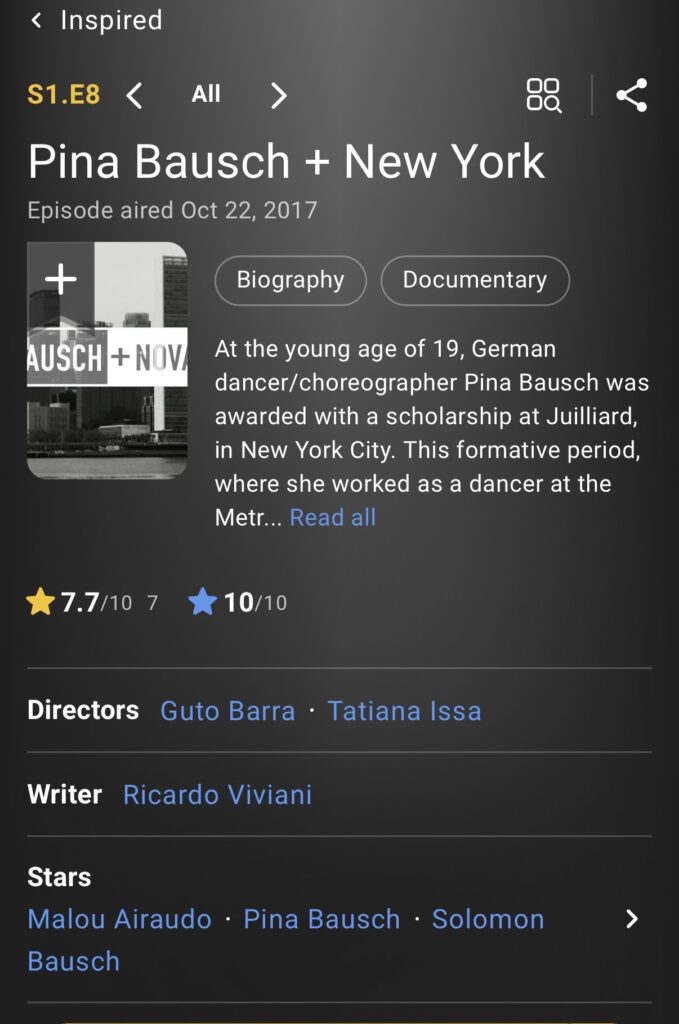
Documentary Film “Pina Bausch + New York”

Pina Bausch + New York
Screenshot IMDB

Type: Publication · Documentary Film · Oral History
Date: 2017
Context: Pina Bausch + New York, part of the series Geografia da Arte
Role: Script Writer · Researcher
Production: Producing Partners NYC in collaboration with the Pina Bausch Foundation
Broadcast: Arte1, Brazil
Locations: New York · Chicago · Woodstock · Wuppertal · Essen


Pina Bausch + New York explored the formative relationship between Pina Bausch and New York through archival research, Oral History and conversations with artists and people connected to her experiences in the United States.

The project was Ricardo Viviani’s first major project at the Pina Bausch Foundation after joining the institution in 2016. It brought together his new role as a researcher at the Foundation with experiences from his own history as a dancer and choreographer in the New York dance environment.

Viviani had first met Pina Bausch personally in New York after performances of Viktor at the Brooklyn Academy of Music. Bausch stayed with dancer Manuel Alum at his loft in TriBeCa, together with her son. Viviani was part of Alum’s performing circle and had known him since his own years at Jacob’s Pillow.

This encounter revealed connections between Viviani’s own formation in the New York dance scene and Bausch’s formative experiences in the United States. When the documentary research began, these intersections became a starting point for tracing the people, places, teachers and artistic encounters connected to Bausch’s early development.

Research

The research extended across a wide range of dance and performing-arts archives and personal networks. Viviani worked with the archives of the Pina Bausch Foundation and the Deutsches Tanzarchiv Köln, as well as collections and institutions in the United States including the 92nd Street Y, Jacob’s Pillow, the New York Public Library’s Dance Collection and the archives of Juilliard School.

At the 92nd Street Y, where Pina Bausch had danced in New York for the first time, Viviani encountered an institution that was also part of his own history as a choreographer, having received a grant and presented work there. At Jacob’s Pillow, he returned to an archive and community he had known since 1980, when he was a scholarship student there, and worked with longtime archivist and curator Norton Owen.

The research also included conversations with dance scholars and critics including Mark Franko and Deborah Jowitt, as well as tracing places, people and artistic networks connected to New York in the late 1950s and early 1960s. Viviani also drew on his own study with Alfredo Corvino and his knowledge of the New York dance environment.

Oral History

The documentary developed an Oral History-based account of Pina Bausch’s formative relationship with New York. Interviews and archival research brought together memories of artists, teachers, collaborators and other witnesses, allowing aspects of Bausch’s early artistic development to be reconstructed through personal testimony and historical sources.

The resulting material provides a record of experiences and encounters that are not always visible in conventional accounts of Bausch’s biography, including the teachers, artistic communities and cultural environments that she encountered in New York and the United States.

Production

The opportunity to produce the interviews arose through an independent coincidence. Rolf Salomon Bausch received a request to collaborate with a New York production company developing a series about artists and geographical places. This led to a collaboration between Producing Partners NYC and the Pina Bausch Foundation.

Interviews and filming subsequently took place in Chicago, New York, Woodstock, Wuppertal and Essen. Although the production company was based in New York, the resulting series was produced for the Brazilian cable channel Arte1.

Producing Partners, led by Tatiana Issa and Guto Barra, was responsible for the production on the New York side.

Archival Material:
Film and production documentation; research notes; Oral History interviews; archival research material; correspondence and production material where preserved; related documentation concerning Pina Bausch’s relationship with New York.


Continue reading “Documentary Film “Pina Bausch + New York””

theaterhagen.de — Choreographic Work for Young Audiences

Märchen zur Weihnachtszeit — Theater Hagen

Representative documentation of Ricardo Viviani’s long-running choreographic work for the Märchen zur Weihnachtszeit at Theater Hagen.

Type: Recurring Practice · Dance Education · Young Audiences · Choreography · Theatre
Period: approximately ten years — documented through individual production records
Institution: Theater Hagen, Hagen, Germany
Role: Choreographer · Dance Educator
Audience: Children · Families · School groups · Young audiences
Status: Historical record · recurring institutional practice documented through individual productions and contemporary press


Record / Description

For approximately a decade, Ricardo Viviani was repeatedly engaged as choreographer for the Märchen zur Weihnachtszeit at Theater Hagen, contributing dance and choreography to a continuing series of productions for children, families and school audiences.

This recurring body of work is best understood as a distinct strand of Viviani’s practice rather than as a collection of unrelated individual productions. The productions combined theatre, music and dance and were presented as major seasonal events for young audiences at Theater Hagen.

The individual productions are documented separately in the archive. This record preserves the larger institutional and artistic relationship: the repeated creation of choreography for young audiences within the Christmas-period programme of Theater Hagen.

The Recurring Practice

The Märchen zur Weihnachtszeit occupied a particular position in the cultural life of Theater Hagen. Contemporary reporting describes the Christmas fairy tale as a long-established pre-Christmas tradition for schools in the region and records audiences drawn from several generations.

A contemporary report from November 2012, on Die Prinzessin auf der Erbse, stated that approximately 30,000 people of all generations were expected to see the production before Christmas, including numerous school classes. The report also describes the Christmas fairy tale as part of the pre-Christmas “curriculum” for many regional schools. It specifically discusses Ricardo Viviani’s choreography and its effect on the predominantly young audience.

The figure of 30,000 is retained here as a contemporary reported expected attendance figure for the 2012 production, not as a calculated cumulative audience figure for the entire period.

Dance and Choreography

Viviani’s role within the series was specifically choreographic. Contemporary Theater Hagen publications and press material repeatedly identify him as choreographer, including documentation for Hänsel und Gretel, Kalif Storch and König Drosselbart.

The 2012 contemporary review of Die Prinzessin auf der Erbse gives additional evidence of the artistic character of this work. It describes Viviani’s choreography as contributing to the atmosphere of the production and specifically connects his choreographic approach with the imagination of a child.

This recurring engagement therefore provides substantial evidence for the development of dance as an integral component of Viviani’s work for young audiences, within large-scale theatrical productions rather than only within dedicated educational workshops.

Young Audiences / Dance Education

The Theater Hagen Märchen work is an important part of the broader Dance Educator strand in Ricardo Viviani’s archive. The audience was not incidental: the productions were conceived and programmed specifically for children, families and school groups.

The Theater Hagen programme for Hänsel und Gretel explicitly describes the responsibility of presenting fairy tales to thousands of children entering the theatre space for the first time and experiencing the performance with all their senses. The production credits Ricardo Viviani with choreography.

The recurring Märchen practice therefore represents a different but complementary form of dance education from workshop-based projects such as Carl & children in Kleve or Carnaval da Dorotéia in Frankfurt: here, children encountered dance through professional theatre productions designed specifically for young audiences.

Production History

The individual production records currently documented in the archive include the Theater Hagen Christmas-period fairy-tale productions for which Ricardo Viviani’s choreographic involvement is recorded. These records should remain the principal sources for individual production facts, dates, collaborators, premieres and production details.

The broader production history includes, among others, Die Prinzessin auf der Erbse, Der Froschkönig, Hänsel und Gretel, Kalif Storch and König Drosselbart, alongside other productions documented in the existing Theater Hagen production records.

Public Reception / Contemporary Documentation

The surviving press material provides unusually valuable evidence of the scale and cultural position of the Märchen series.

In November 2012, TV58.de reported on Die Prinzessin auf der Erbse and described an expected audience of approximately 30,000 people of all generations, including numerous school classes. The article emphasizes the long-established relationship between the Christmas fairy tale and regional schools and discusses Viviani’s choreography as an important part of the production.

In November 2013, Lokalkompass Hagen reported on the Märchenwerkstatt for Der Froschkönig, identifying Ricardo Viviani as choreographer and describing the public workshop as an opportunity to see the production process and meet members of the creative team.

Contemporary material for Hänsel und Gretel, Kalif Storch and König Drosselbart further documents Viviani’s continuing choreographic role in the series.

Institutional Context

The importance of the Märchen series lies not only in the individual productions but also in its institutional continuity at Theater Hagen. The recurring format connected professional theatre-making with a large and returning young audience, including organised school attendance and family performances.

The available documentation indicates that the theatre treated these productions as an important part of its relationship with younger audiences, while the recurring engagement of Viviani established continuity in the choreographic language of the series.

Contribution / Significance

The Theater Hagen Märchen series represents a substantial body of work in Ricardo Viviani’s development as a choreographer working with young audiences.

It demonstrates that his work with children and families extended beyond isolated educational projects into sustained professional theatre practice, where choreography formed part of large-scale productions experienced by school groups, families and multigenerational audiences.

The contemporary evidence of large attendance, repeated school participation and the theatre’s stated responsibility toward first-time young theatre visitors gives this strand particular relevance to the archive’s developing Dance Educator / Young Audiences history.

Assessment / Relevance

This recurring Theater Hagen practice is one of the strongest pieces of evidence for a long-term young-audience dimension in Viviani’s career.

It should therefore be read alongside, rather than merged with, his school-based dance education projects, cultural mediation projects and later young-audience activities. Together these records establish a broader professional strand in which dance functions as artistic creation, communication and access to culture for younger generations.

Archival Material

Surviving and identified documentation includes: individual Theater Hagen production records; Theater Hagen season programmes and theatre newspapers; contemporary press coverage; Märchenwerkstatt documentation; production photographs and other surviving visual material; and the broader Theater Hagen production list.

The 30,000 figure is retained specifically as the contemporary reported expected audience for the 2012 production Die Prinzessin auf der Erbse. It should not currently be presented as a cumulative attendance figure for the entire approximately ten-year period.

Keywords

Theater Hagen · Märchen zur Weihnachtszeit · Christmas fairy tale · young audiences · children · families · school groups · dance education · Dance Educator · choreography · children’s theatre · family theatre · cultural education · Die Prinzessin auf der Erbse · Der Froschkönig · Hänsel und Gretel · Kalif Storch · König Drosselbart · Ricardo Viviani


External Links

TV58.de — Märchenhaftes Musical zur Weihnachtszeit am theaterhagen, 2012

Lokalkompass — Märchenwerkstatt im Theater Hagen: Der Froschkönig, 2013

Lokalkompass — Hänsel und Gretel, 2015

Theater Hagen — Spielzeitheft 2015/16: Hänsel und Gretel

Theater Hagen — Spielzeitheft 2016/17: Kalif Storch

Theater Hagen — Theaterzeitung: König Drosselbart, 2017

Internal Links

Productions — complete production list


Existing Theater Hagen production records


Archival Note

This record documents the recurring institutional and artistic practice of Ricardo Viviani’s work as choreographer for the Märchen zur Weihnachtszeit at Theater Hagen. Individual productions remain the primary records for production-specific facts and should not be duplicated here. Contemporary press and institutional publications are used to document the scale, continuity and young-audience context of the series. Attendance figures are retained according to their original documentary meaning and are not converted into cumulative estimates without further evidence.

Hänsel und Gretel Musical

alt text of photo

„Ein Kind, dem nie Märchen erzählt worden sind, wird ein Stück Feld in seinem Gemüt behalten, das in späteren Jahren nicht mehr angebautwerden kann.“ Johann Gottfried von Herder, Schriftsteller, Philosoph und Theologe der Aufklärungszeit

Unermüdlich erzählen wir deshalb auf der Bühne Märchen – immer in der Verantwortung, dass tausende Kinder zum allerersten Mal den Theaterraum betreten und mit allen Sinnen dem Bühenerlebnis entgegenfiebern.

In diesem Jahr präsentieren wir ein Märchen, das zu den meist erzählten gehört – aber auch zu den meist umstrittenen: Eltern bringen aus sozialer Not ihre beiden Kinder tief in den Wald und hoffen, dass Hänsel und Gretel dort verloren gehen.
Auf ihrem Irrweg gelangen die ausgestoßenen Kinder an das Lebkuchenhaus einer Menschen fressenden Hexe. Mit List können sich beide befreien und kehren mit reichlich Schmuck und Nahrung zurück zum Elternhaus.

Entgegen der Haltung der 70er Jahre, die das Erzählen der Volksmärchen in Frage stellte, werden wir uns gemeinsam mit den jungen Gästen hinein stürzen in diese Geschichte über böse und gut, dumm und schlau, traurig und lustig, hungrig und satt, dunkel und hell, unglücklich und glücklich.


theaterhagen