I am writing this letter to advise you that Ricardo Viviani is a valuable teacher to any performance program. He has taught for the State University of New York at New Paltz Study Abroad dance program in Prague and in Italy for many years.
He offers, from his incredible performing experience over the years as a dancer and a choreographer of opera and musicals, a unique approach to teaching which captures the students immediately with his energy. The workshops he gave were always a high point in the program and valued highly by the students and by me.
You will be very fortunate to have him as a teacher.
Sincerely Lynn Barr [Director of SUNY STUDY DANCE ABROAD]
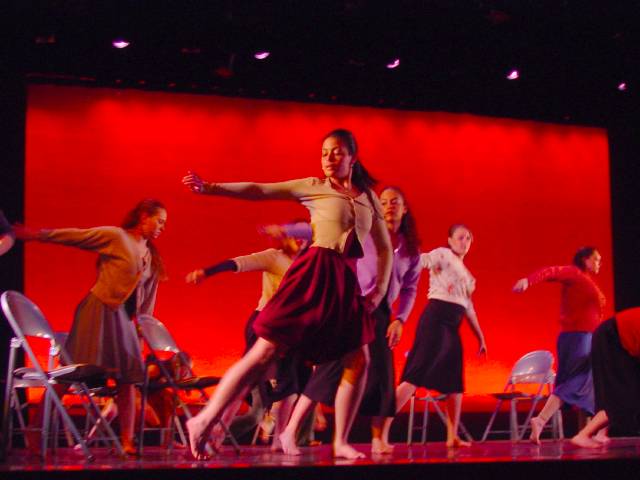
The spring concert represents a culmination of two semesters of work by students in the Performance and Applied Dance class. The program, which will feature approximately 30 DCC students, includes modern dance choreography by Zanchetti and guest choreographers Julie Manna and Ricardo Viviani
Everything that he did was carefully thought out and designed as being fun for the students in the class. He knew when and where to stop and how to better explain moves to the class when everyone had trouble with it. He was also not boring.
He showed that dancing was acting as much as a physical activity. He encouraged us to get involved emotionally into pieces and really be in the piece.
Overall, I thought that Ricardo Viviani was a great dance teacher. He really liked what he was doing. His passion toward dancing was contagious. He made everybody like dancing. He was extremely professional. He also had a good easy going dancing style. Continue reading “a student report 2004”
Colchões Ortopédicos — an evening of Brazilian new dance, Dance Space, New York City, 29–30 October 1988.
Type: Production · Dance Concert / Presentation Date: 29–30 October 1988 Time: 8:00 PM Context: An evening of Brazilian new dance presenting repertory works and new works by Ricardo Viviani Location: Dance Space, 622 Broadway, New York City Institution / Organisation: Dance Space; self-produced by Ricardo Viviani; assisted by Dance Theater Workshop Role: Choreographer · Performer · Producer / Presenter Participants: Ricardo Viviani; Cheryl Hartley; Fernanda Meyer; Mark Bridges; Marcelo Galbetti; Fernando Vugman; additional production personnel as documented below Status: Historical Record — documented by surviving programme and press material
Record / Description
Colchões Ortopédicos was the title of Ricardo Viviani’s self-produced
evening of Brazilian new dance presented at Dance Space in New York City
on 29 and 30 October 1988. The surviving programme describes the event
as an evening bringing together repertory and newly developed works,
and identifies Dance Theater Workshop as an assisting organisation.
The programme documents six works: Girl, Serious Talk,
Blue Danube, Pavões, Colchões Ortopédicos
(Orthopedic Mattresses) and Rubber Gloves. It therefore
provides an important production-level record of a period in which
Viviani’s Brazilian and New York choreographic histories were being
brought together within the context of what was described publicly as
Brazilian new dance.
The production is particularly significant because the programme does
not present the works as isolated creations. It places works from
different moments of Viviani’s development into one evening, including
Blue Danube, identified as dating from 1982, Colchões
Ortopédicos, dated 1984–88, and Rubber Gloves, identified
as a 1988 premiere. This chronology makes the concert an important
document for understanding the continuity and transformation of
Viviani’s choreographic practice during the 1980s.
The Work / Creation
The surviving programme establishes the following six works within the
concert:
Girl — solo; music by Tom Jobim; choreography by Ricardo Viviani; danced by Cheryl Hartley.
Serious Talk — duet; music by Antonio Carlos Jobim; choreography by Ricardo Viviani; danced by Cheryl Hartley and Ricardo Viviani.
Blue Danube (1982) — solo; choreography by Ricardo Viviani; danced by Ricardo Viviani with Cheryl Hartley identified in the programme documentation.
Pavões — work in progress; music by Heitor Villa-Lobos; costumes by Mark Bridges; danced by Fernanda Meyer.
Colchões Ortopédicos / Orthopedic Mattresses (1984–88) — solo; text by Fernando Vugman; costumes by Mark Bridges; additional music by Marcelo Galbetti; bilingual version, choreography and soundtrack by Ricardo Viviani; danced by Ricardo Viviani.
Rubber Gloves (1988) — premiere; duet; music by Heitor Villa-Lobos; costumes by Mark Bridges; choreography by Ricardo Viviani; danced by Cheryl Hartley and Ricardo Viviani. The programme notes that the solo in Rubber Gloves was dedicated to Viviani’s father.
These works should ultimately receive individual records where their
histories, movement vocabularies, collaborators, music, costumes,
performances and critical documentation can be developed in detail.
This production record should remain focused on their coming together
within the 1988 concert.
Activity / Event
The concert took place on Saturday 29 and Sunday 30 October 1988 at
8:00 PM at Dance Space, 622 Broadway, New York City. The surviving
programme identifies the event as a presentation by Ricardo Viviani
and describes it as an evening of Brazilian new dance.
The concert was self-produced and was assisted by Dance Theater
Workshop. The programme acknowledges Norman Kean, Ron Nash, Maria di
Dia and the staff of the Edison Theater, particularly Karen, together
with Tim McCormack, Phil Barbieri, Jodi Johnson, Bob Hillebrecht and
Dan Carter. The production crew is identified as Jim Garvey, Mel
Marwitz, Linda Miller and McCormack.
Production
The production was organised around a repertoire that crossed several
phases of Viviani’s choreographic work. The programme itself provides
a useful internal chronology: Blue Danube is identified as a
1982 work; Colchões Ortopédicos as dating from 1984–88; and
Rubber Gloves as a 1988 premiere. Pavões is described
as a work in progress.
The production also brought together a group of collaborators whose
work extended beyond performance. Cheryl Hartley performed in several
of the works; Fernanda Meyer performed Pavões; Mark Bridges
was responsible for costumes for Pavões, Colchões
Ortopédicos and Rubber Gloves; Fernando Vugman contributed
the text for Colchões Ortopédicos; and Marcelo Galbetti
provided additional music for that work.
The programme’s biographical material also places these collaborators
within Viviani’s wider New York professional network. Cheryl Hartley is
identified as having danced on Broadway in Oh! Calcutta! and
as having toured Europe and the Middle East with Viviani. Mark Bridges
is identified as a costume designer with theatre, film and television
credits. Fernanda Meyer is described as a dancer, choreographer and
teacher with professional activity in São Paulo, Japan, San Francisco
and New York.
Intellectual Production
The production is also relevant to Viviani’s broader investigation of
the relationship between humanity, technology, gesture and movement.
However, the surviving 1988 programme functions primarily as production
and historical documentation rather than as a separate intellectual
publication. More developed statements concerning choreographic
methodology, technology and the conceptual framework of individual
works should be documented in their respective work or intellectual
production records.
Primary Source / Documentation
The principal surviving production document currently located is the
eight-page programme and press dossier for Colchões Ortopédicos,
dated October 1988. It contains the event announcement, programme,
artist biographies, acknowledgements, press listings and contemporary
press material.
The programme establishes the exact performance dates, venue and
address, the title of the evening, the six works presented, individual
credits, performers, costume and music contributions, production
assistance and a number of contemporary press references. It is
therefore the primary source for the production metadata presently
recorded on this page.
The same document contains contemporary press material describing
Viviani as a São Paulo-born dancer and choreographer presenting an
evening of Brazilian new dance in New York. One clipping states that
the concert would present repertory pieces and new works, while another
lists the Dance Space performances on 29 and 30 October.
The programme also preserves an important connection with the earlier
history of Colchões Ortopédicos. It identifies the work as
dating from 1984–88 and states that it had first been presented at
Dança na Praça, an outdoor festival in São Paulo, Brazil.
This provides a documented bridge between the Brazilian origins of the
work and its New York development.
The programme further preserves the contemporary terminology
surrounding the event: the evening is repeatedly described as
Brazilian new dance. This wording is useful historically because it
places Viviani’s work within the presentation and reception of Brazilian
modern / contemporary dance in New York during the late 1980s.
Research
This production is a key source for reconstructing the development of
Viviani’s choreographic practice during the 1980s. The chronological
spread of the works makes it possible to examine how movement ideas,
performance relationships, music, costume and technological or
structural approaches persisted and changed across several years.
Serious Talk is particularly relevant to the history of
Viviani’s interest in technology and systems of movement organisation.
Earlier documentation connects the work with an outdoor project in
Brazil and with computer-mediated variation of movement material.
The exact chronology of its original creation should be reconciled
against the surviving programme, interview material and other archival
sources rather than assumed from a single later recollection.
Blue Danube provides another important chronological marker.
The 1988 programme dates the work to 1982, while surviving New York
documentation records its presentation with Cheryl Hartley and later
critical response. The existing Blue Danube record should be
expanded as an individual work record and then linked back to this
production.
Colchões Ortopédicos is equally important because the programme
gives it a 1984–88 date range and records its development from the
Brazilian Dança na Praça context into the New York production.
Its combination of text, bilingual presentation, soundtrack,
choreography and additional music makes it a particularly useful
individual record for documenting Viviani’s dance vocabulary and
collaborative practice.
Relationship
This production is directly related to the six works documented in the
1988 programme: Girl, Serious Talk, Blue Danube,
Pavões, Colchões Ortopédicos and Rubber Gloves.
The production record establishes their relationship as a single
concert programme; the individual work records should document their
independent histories.
The production is also related to the professional collaboration
between Ricardo Viviani and Cheryl Hartley, as well as to Mark Bridges’
costume work. These relationships connect the concert to Viviani’s
wider New York performance history, including his professional
association with Oh! Calcutta!.
The production is further connected to Viviani’s Brazilian choreographic
history through Colchões Ortopédicos and the documented
reference to Dança na Praça in São Paulo.
Place / Context
The 1988 concert belongs to the New York phase of Viviani’s professional
career while retaining a strong connection with his Brazilian
choreographic background. The programme explicitly presents the event
as Brazilian new dance and identifies Viviani as a dancer and
choreographer from São Paulo.
Dance Space, at 622 Broadway, provided the New York setting for the
presentation. The production’s self-produced character, combined with
assistance from Dance Theater Workshop, is also significant: it
documents an independently organised presentation supported by an
established dance organisation rather than a conventional commercial
production structure.
Selected Work Contexts
Colchões Ortopédicos / Orthopedic Mattresses:
The programme dates the work 1984–88 and credits text by Fernando
Vugman, costumes by Mark Bridges, additional music by Marcelo
Galbetti, and choreography, soundtrack and bilingual version by Ricardo
Viviani. It was first presented at Dança na Praça, an outdoor
festival in São Paulo. The work deserves a separate expanded record
dealing with its movement vocabulary, text, soundtrack, bilingual
structure and relationship to the later New York presentation.
Blue Danube:
The 1988 programme identifies the work as dating from 1982. Existing
documentation of its New York presentation records Ricardo Viviani and
Cheryl Hartley and includes contemporary critical response, including
Jennifer Dunning’s observation in The New York Times that the
quality of movement in Blue Danube was particularly subtle and
interesting. The individual work record should be developed as a
pivotal document of Viviani’s early choreographic vocabulary.
Serious Talk:
The programme identifies the work as a duet performed by Cheryl Hartley
and Ricardo Viviani, with music by Antonio Carlos Jobim. Earlier
documentation associates the work with a Brazilian outdoor project and
with computer-mediated organisation of movement sequences. The
chronology of its original creation should be established through
comparison of the surviving interview, programme and other archival
sources.
Pavões:
The programme describes the work as a work in progress, with music by
Heitor Villa-Lobos, costumes by Mark Bridges and Fernanda Meyer as
performer. The work is part of the Brazilian cultural and Carnival-related
material that appears elsewhere in Viviani’s archive. Mark Bridges’
recollection concerning the exceptionally large rear section of
Fernanda Meyer’s costume — and his having to carry or walk with it
through Manhattan from Midtown toward the venue — should be preserved
in the individual work record as an identified personal recollection,
rather than as independently verified production fact.
Girl:
The programme identifies Girl as a solo choreographed by
Ricardo Viviani and danced by Cheryl Hartley, with music by Tom Jobim.
Its inclusion in the 1988 concert links the work to Viviani’s ongoing
collaboration with Hartley.
Rubber Gloves:
The programme identifies Rubber Gloves as a 1988 premiere,
performed as a duet by Cheryl Hartley and Ricardo Viviani, with music
by Heitor Villa-Lobos and costumes by Mark Bridges. It also records
that the solo in the work was dedicated to Viviani’s father. This work
was omitted from the earlier reconstruction of the concert and should
now be treated as part of the documented 1988 programme.
Personal Reflection
[Add Ricardo Viviani’s retrospective reflection on the 1988 concert,
the decision to present these works together, the experience of working
with Cheryl Hartley and Mark Bridges, and the relationship between the
Brazilian origins of the work and its New York presentation.]
Archival Material
Eight-page Colchões Ortopédicos programme / press dossier,
October 1988; concert postcard; press clippings; contemporary listings;
documentation for Girl; documentation for Serious Talk;
documentation for Blue Danube; documentation for Pavões;
documentation for Colchões Ortopédicos; documentation for
Rubber Gloves; video documentation where available; photographs;
and related archival correspondence and production material.
… Darkly handsome, Viviani has the masculine power of the young Robert Mitchum, but he’s hot, not cool. Joining Hartley for Serious Talk, he’s slightly menacing, controlled, agressive — but unhurried. A ’40s film noir, Mickey Spillane kind of guy — but he doesn’t lay a hand on her. … Viviani’s in formal pants, black suspenders, a sleeveless undershirt. He slowly raises his arms, folds them across his chest. He points his index finger, then with the other hand pushes softly in the opposite direction with measured force. Repeating gestures, speeding them up, adding more, he produces a steady flow of contradictory impulses, while playing off the waltz rhythms. He opens his hands with a kind of helpless strength, then draws them in to his chest and cringes. The accelerating repetition of impassioned gestures gradually builds as unbearable pressure of feeling in him.
The New York Times by Jennifer Dunning
Blue Danube – New York City
… Mr. Viviani, a relatively new choreographer, took simple themes and dealt with them with admirable simplicity … The quality of movement is most subtle and interesting in “Blue Danube,” set to the Strauss waltz, its message is mystifying. Mr. Viviani and Cheryl Hartley were personable dancers.
…”Mr. Perry moves his 12 dancers about the tiny space impressively, giving them big jumps – crisply executed -and runs for a note of urgency.” Jennifer Dunning
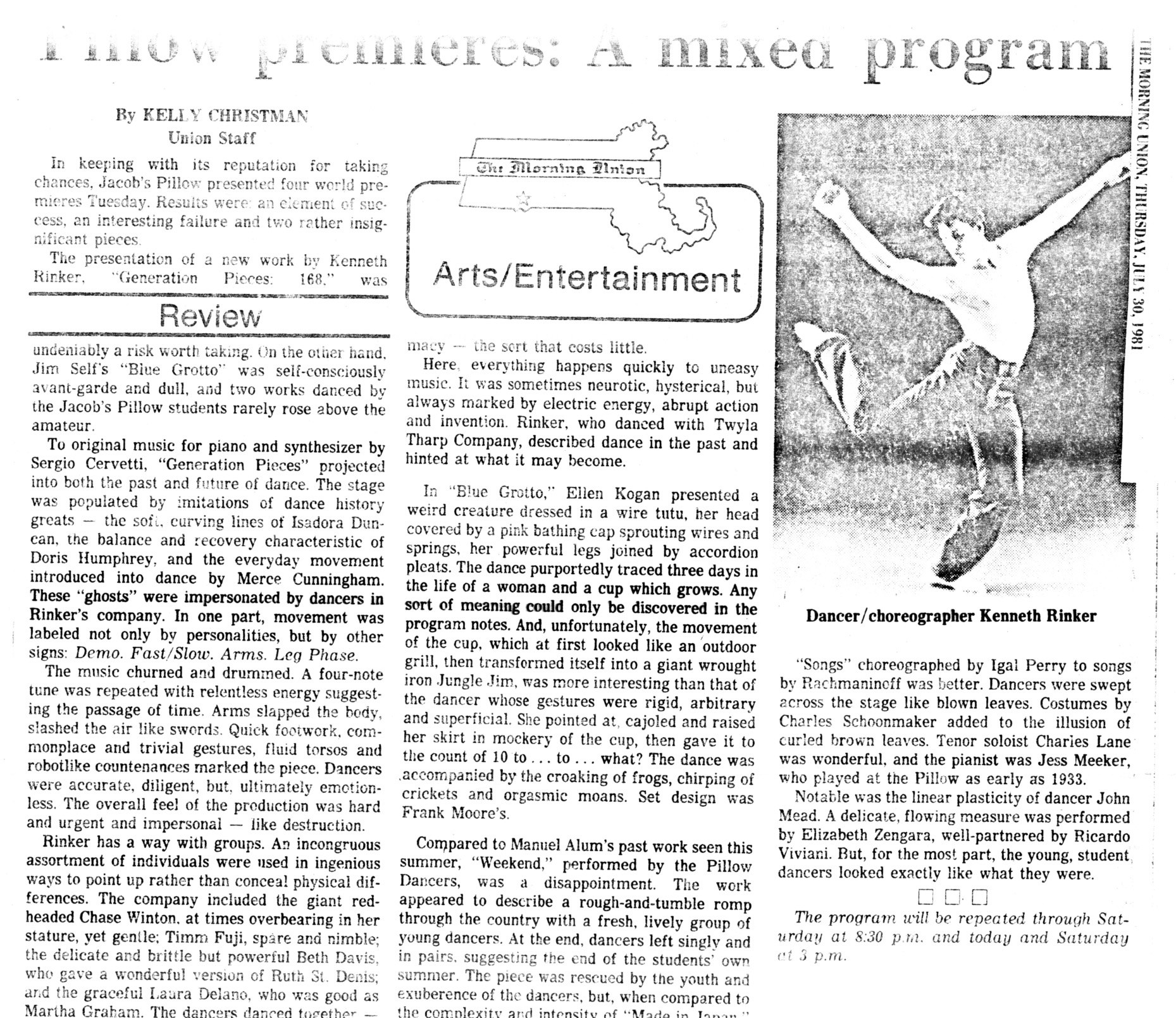
…”A delicate, flowing measure was peformed by Elizabeth Zengara, well-partnered by Ricardo Viviani”
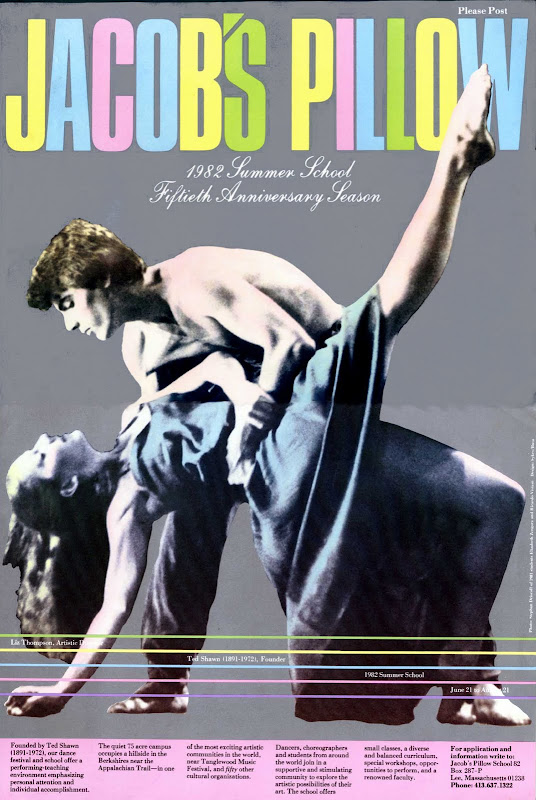
Jacob’s Pillow is a very special place. The school is a summer camp; the students live in cabins scattered around the woods of the Berkshire Mountains. The program includes an intensive dance education with 5 dance classes per day. The scholarship program also includes work on the many skills needed for running a dance performance: this way the students are also involved in the performances presented at the Dance Festival.
“The Pillow” first introduced me to Bessie Schönberg, Liz Thompson, Manuel Alum, Bill Irwin, the Kathakali Dance of India and so many other people.
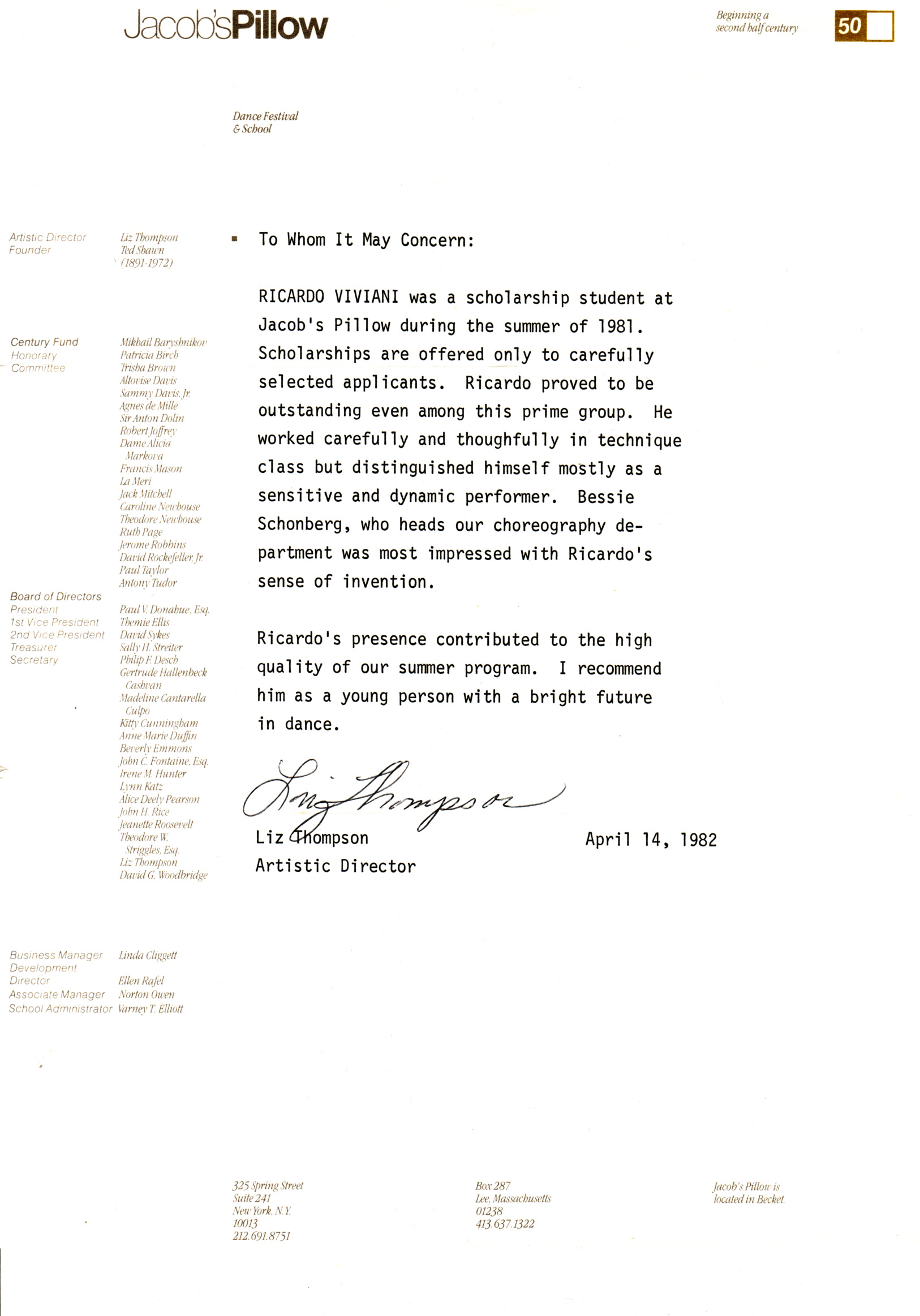
”Bessie Schönberg, who heads our choreography department was most impressed with Ricardo’s sense of invention.”
 I am writing this letter to advise you that Ricardo Viviani is a valuable teacher to any performance program. He has taught for the State University of New York at New Paltz Study Abroad dance program in Prague and in Italy for many years.
 The spring concert represents a culmination of two semesters of work by students in the Performance and Applied Dance class. The program, which will feature approximately 30 DCC students, includes modern dance choreography by Zanchetti and guest choreographers Julie Manna and Ricardo Viviani