Just Call Us Dancers

Just Call Us Dancers — Oral History in the Performing Arts
Just Call Us Dancers — presentation material

Type: Presentation · Oral History
Date: 17 October 2019
Context: Oral History Association Annual Meeting, Pathways in the Field: Considerations for those Working In, On, and Around Oral History
Location: Sheraton Salt Lake City Hotel, Salt Lake City, Utah, USA
Panel: Oral History in Artistic Mediums
Role: Presenter · Researcher
Affiliation: FernUniversität in Hagen

Panel Participants:
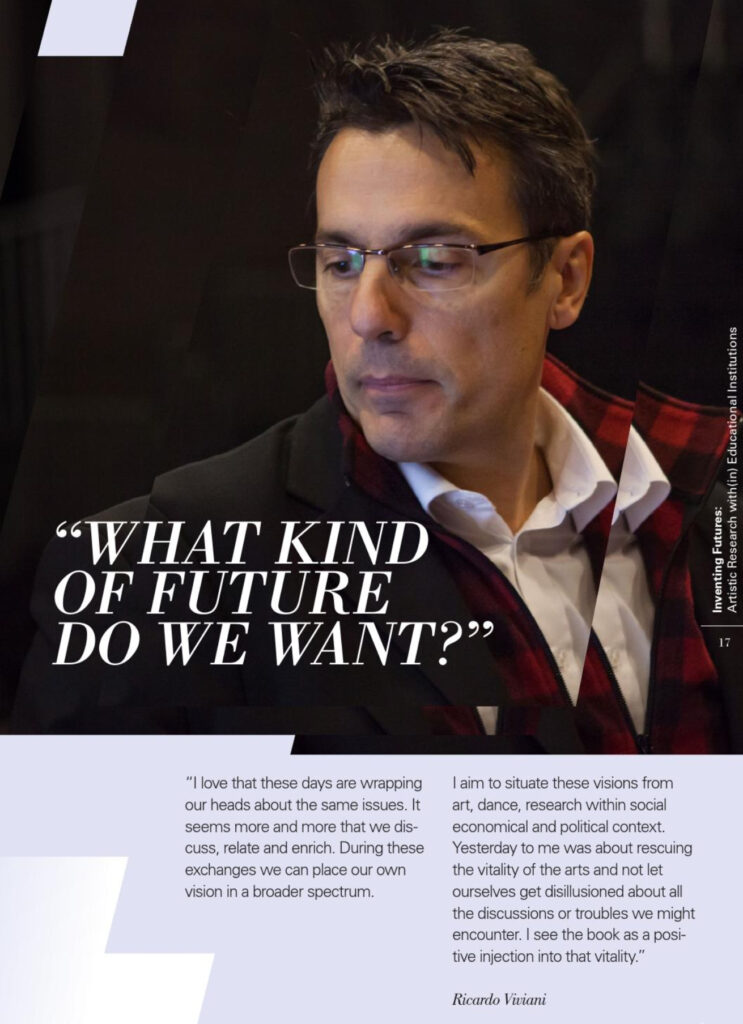
Ricardo Viviani
Kenneth Horowitz
Daniel Horowitz Garcia


In the winter of 1980/81, I was awarded a scholarship to study at a dance studio located at 400 Lafayette Street in New York City. The name of this studio was Dancerschool. The studio was part of the life work of Dennis Wayne, a star dancer of the 1970s. His company was called “Dancers”, just the word “Dancers”. The simplicity of that name indicates that what they do should suffice.
The art speaks for itself. 

The title Just Call Us Dancers comes from this memory. It is therefore both a reference to that particular moment in my own formation and a question about what can be communicated by the practice itself, before it is translated into explanatory language.

Just Call Us DancersOral History in the Performing Arts was a presentation about Ricardo Viviani’s pathway from dance and choreography into Oral History and about the methodological questions that arise when oral history is applied to a predominantly non-verbal art form.

The presentation was deliberately personal. Using slides that included images from Viviani’s early years as a dancer, it traced a path that began with his unexpected discovery of dance while studying Biology at the University of São Paulo. During university strikes, he encountered a dance group forming in the Faculty of Architecture (FAU). The group, composed of amateur dancers, chose the deliberately grand institutional name Corpos de Baile. What began as a moment of curiosity became a professional artistic trajectory.

A year or two later, Viviani entered the Escola de Comunicações e Artes — Escola de Arte Dramática (ECA-EAD) at the University of São Paulo to study Theatre Direction, as a dance programme was not available there in 1979. His teachers directed his attention toward non-verbal communication, giving him a way of thinking about performance beyond spoken language.

This formation took place during the Brazilian Military Regime. Viviani observed how music, theatre and dance could contain several layers of meaning and how artists developed forms capable of communicating around censorship. Learning to create and read these layers of meaning became useful to him as a choreographer and remained part of his artistic practice.

The presentation then followed the longer development of this interest: from early choreography and a continuing attention to non-verbal communication, through years of artistic practice and further study, to Viviani’s later decision to investigate these questions more systematically.

Alongside his work as a choreographer, Viviani returned to formal study through Cultural Sciences (Kulturwissenschaften) at FernUniversität in Hagen. He regarded this as continuing education rather than a break from his artistic practice. Through these studies he encountered Oral History and recognized a methodological correspondence with questions he had carried through his artistic life: how can knowledge embedded in lived practice be investigated, articulated and placed within a historical context?

The presentation argued that dancers can be unusually difficult interview subjects because dance contains forms of knowledge that are not primarily verbal. Studio communication can be pragmatic, affective, metaphorical and inseparable from movement. The challenge for the interviewer is therefore not simply to ask dancers to explain what they know, but to create conditions in which aspects of their experience can become narratable.

A related question concerned the role from which knowledge is acquired. In an institutional dance environment, dancers experience creative processes according to their position within the theatre structure. Their memories therefore contain not only individual recollection, but knowledge shaped by their particular role, relationships and responsibilities.

The presentation also introduced the idea that apparently simple biographical questions can open onto much wider historical contexts. A question such as “How did you start to dance?” may begin as a personal biography and lead toward histories of education, cultural identity, political circumstances and artistic formation. The interview becomes a space in which these unexpected connections can emerge.

One example from Viviani’s Oral History work concerns a dancer’s account of learning ballet in Dublin during the 1970s. What begins as a question about entering dance opens onto questions of cultural identity and the experience of studying ballet within a context shaped by the colonial relationship between Ireland and the United Kingdom. Such moments demonstrate how the apparent simplicity of a life-history question can reveal wider historical structures.

The presentation therefore positioned Oral History not simply as a means of collecting memories, but as a form of inquiry in which the specific knowledge of the interviewer and the artistic field can help open questions that might otherwise remain inaccessible.

Archival Material:
Presentation slides; presentation PDF; conference programme; research notes; related Oral History interview material; documentation of subsequent work on non-verbal communication in interviewing.


Continue reading “Just Call Us Dancers”
morphogenesis

Ricardo Viviani performing Blue Danube
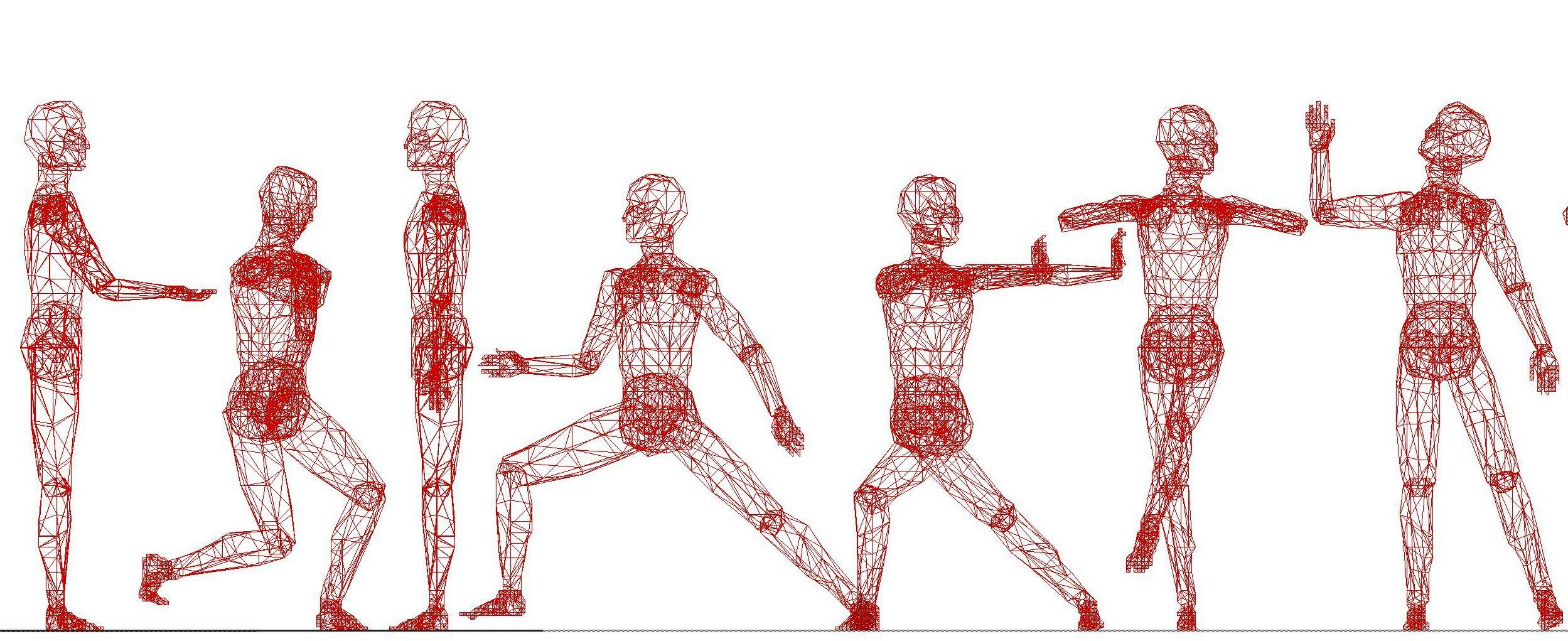
Analysis of Blue Danube using Life Forms — Ricardo Viviani 2015

Type: Presentation Proposal · Lecture-Demonstration
Date: 31 July 2015
Context: Artistic Research / Dance Creation
Location: Frankfurt am Main, Germany
Role: Choreographer · Researcher
Status: Proposal · Never presented


Morphogenesis in Dance
The Shaping of Artistic Creation

This lecture-demonstration proposal asks: “What gives shape to things?”

Three approaches to morphogenesis in dance
Three approaches to observing creation

Three approaches to observe the process of creation.

Format: Lecture / performance

In this lecture-performance, three theoretical models of morphogenesis are exposed and a live example is performed.

1. What is Morphogenesis?

What gives shape to things?

Morphogenesis is the process that determines how biological forms are differentiated and organized. A right or a left limb has the same genetical materials; why and how it takes one form or another is not biologically fully explained yet.

Performance undergoes similar processes: the coding and rules of genetics as in the modes of communication, the materials and mechanics of genes in the instruments and scores, dance steps and the bodies, are present in the same way. The moment of decision that differentiates and piles up a cell in one way or another, and the combination of one movement next to another, has been the subject of theories in the recent past.

Three approaches to this issue are presented here, from biology, from quantum physics applied to Jungian psychology, and from performance studies.

1.1 Chreode

A neologism created by biologist Conrad H. Waddington in his book The Strategy of the Genes from 1957, chreode (chre — necessary and hodos — path) is explained by using an analogy that uses gravity as an easy-to-relate phenomenon in the physical world: a ball rolling along a path. The theory of chreode provides for self-organisation, natural temporal framework and variation of form.

1.2 Attractors

In combining chaos theory with Jungian Archetypes, psychologist John R. Van Eenwyk creates a possible model that inverts causation and lends to behavior with posterior causation. The future pulls creation as opposed to being pushed from the past. Creativity in this sense, most likely, operates freed from natural time.

1.3 Viscosity

Portuguese philosopher José Gil introduces the concept of “viscosity” to explain movement choices in his article “O Corpo Paradoxal” (Paradoxical Body) in his book Movimento Total – O Corpo e a Dança from 2001. According to his postulate, dance is channeled through paths of lower viscosity that are sensed by the dancer in the act of dancing.

2. Observing Morphogenesis in Performance

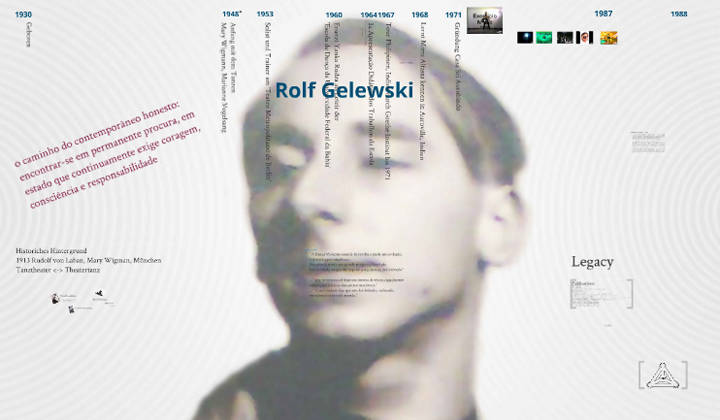
Rolf Gelewski
Rolf Gelewski — presentation material

In dance, morphogenesis can be observed both in the rehearsal room by observing specific interactions of the choreographer and dancer, but also in performance by restricting some parameters and concentrating the observation on specific variables.

To access the creation moment, this presentation will use a methodology developed by German dance pedagogue Rolf Gelewski. Gelewski is a disciple of Mary Wigman in the analytical genealogy of Rudolf von Laban.

Rolf Gelewski was a dancer and educator born in 1930 in Berlin. Acclaimed by the press in the 1950s as a new Harald Kreuzberg, he was sent by Mary Wigman to establish the first contemporary dance education program in the University of Salvador, Bahia, Brazil in the 1960s. His later pedagogical work structured a methodology to access the creative impulse in a dance yoga-like meditation system. His influence also reaches the Auroville community in India. Gelewski was killed in a car accident in 1986.

3. Summary

Models for explaining morphogenesis in performance transcend the natural sciences toolkit; still, it can be observed and described. This lecture-demonstration proposes three approaches to observe this phenomenon.

After exposing these theories, a short dance piece will be performed to enable an observation under the aspects of morphogenesis of a moment of creation. This dance piece — Blue Danube — presents a frame that constrains the observable phenomenon of improvisation in three parameters: Force, Speed and Timing.

An early full video of this dance can be seen here: Blue Danube @ DanceSpace NYC 1986.


Life Forms

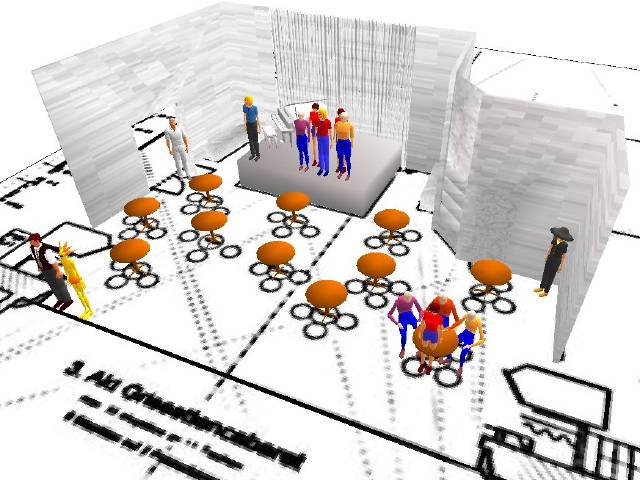
The proposal also used Life Forms for the visual analysis of human movement. The software became an important tool in Viviani’s choreographic work and was used intensively in several productions in the early 2000s.

Later Development

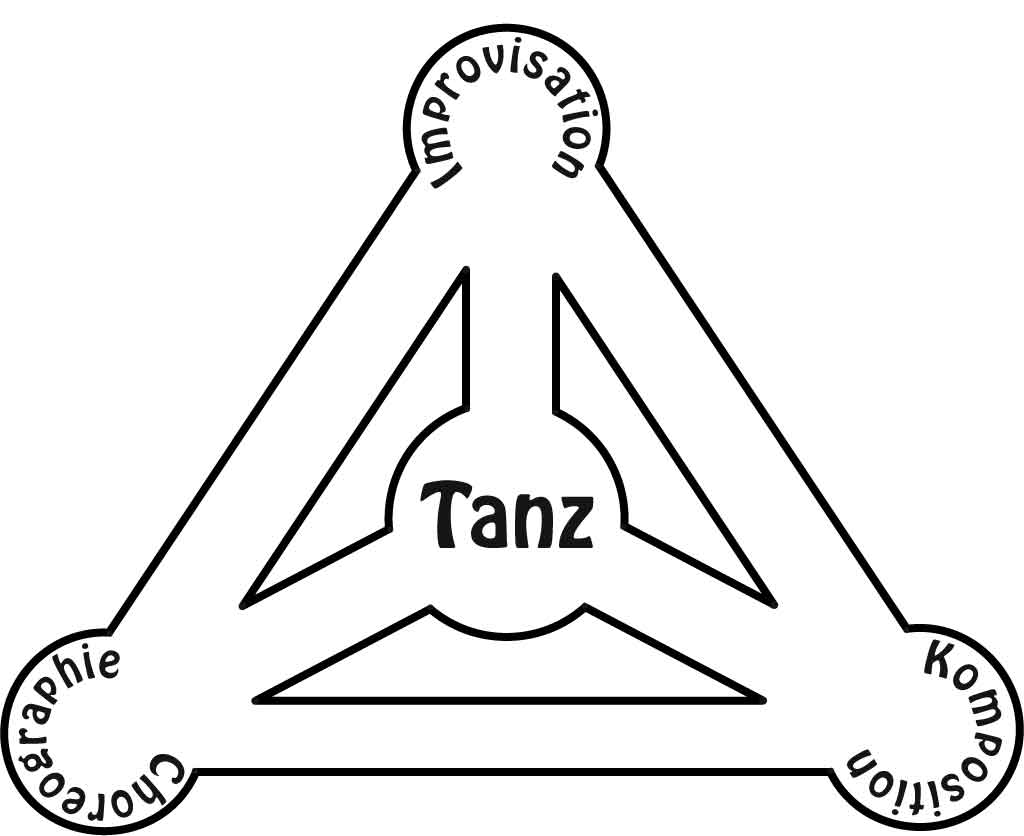
A working vocabulary that developed from this line of inquiry later became important in Viviani’s thinking about dance creation, particularly the distinctions between improvisation, choreography and composition. These distinctions belong to later work and are not presented here as a completed triad in the 2015 proposal.

Formal Requirements

The original proposal specified the following technical requirements:

  • Duration: Introduction 15 minutes, demonstration 10 minutes
  • Stage dimensions: minimum 8 meters wide, 2 meters deep
  • Equipment: video projector and computer for PowerPoint, and PA system for music playback

Archival Material:
Lecture-demonstration proposal, version 1.0 EN, 31 July 2015; PDF handout; presentation images; Life Forms analysis; related Blue Danube documentation.


Continue reading “morphogenesis”

why. what. how. 2014

lectures

Lectures and Research

The Secret: What do dancers know?

‘Dance is at the bottom of the food chain.’ (William Forsythe 2009)

Neuroscientists, philosophers, and also dance academics of all sorts have been trying to figure out what it is: what do dancers know that other people can’t grasp? Unless they’ve been through the mill of arduous training and rehearsing, they have no way of knowing it. Call it embodied knowledge, somatic intelligence and so forth, it is rarely articulated by dancers, so there’s little understanding of it outside the dancer’s circle. It is a secret. A secret not by intention but by virtue of its nonverbal nature.

Continue reading “why. what. how. 2014”

Inventing Futures ArtEZ

ArtEZ report for Inventing Futures, 2013
ArtEZ Report — Inventing Futures, 2013

Title: Crie Futuros / Create Futures Movement
Type: Presentation · Artistic Research / Education
Date: 2–3 December 2013
Context: Inventing Futures — Artistic Research With(in) Educational Institutions
Location: ArtEZ Arnhem, The Netherlands
Role: Presenter · Researcher


Crie Futuros / Create Futures Movement

The presentation introduced the ideas of Brazilian choreographer, futurologist, creative-economy consultant and activist Lala Deheinzelin, drawing particularly on her book Desirable New World. The presentation considered how intangible resources such as culture, creativity and wellbeing can contribute to a sustainable and attainable future.

From the perspective of a choreographer, the presentation asked how knowledge developed through dance and performance might contribute to broader questions of creativity, participation and social development. A central question was: What do dancers know that non-dancers can’t grasp?

The presentation approached dance practice as a source of knowledge that is often implicit and difficult to articulate outside the circle of dancers. It connected physical and pedagogical practice with questions of communication, collaboration, decision-making and ways of understanding intangible resources.

Deheinzelin’s framework also proposed a methodology for imagining futures through inventing futures, pooling resources, collaborative models, identifying resources and measures, and implementation. In this context, choreographic knowledge was considered as one possible contribution to broader strategies for creating desirable futures.

The presentation was part of Crie Futuros Movement within the conference discussion of artistic research in educational institutions.

Archival Material:
ArtEZ report; presentation slides / Prezi; presentation script; bibliography and source materials.


Continue reading “Inventing Futures ArtEZ”

State University of New York 2008

Letter of Recommendation

dance in pragueI am writing this letter to advise you that Ricardo Viviani is a valuable teacher to any performance program. He has taught for the State University of New York at New Paltz Study Abroad dance program in Prague and in Italy for many years.
He offers, from his incredible performing experience over the years as a dancer and a choreographer of opera and musicals, a unique approach to teaching which captures the students immediately with his energy. The workshops he gave were always a high point in the program and valued highly by the students and by me.
You will be very fortunate to have him as a teacher.
Sincerely Lynn Barr [Director of SUNY STUDY DANCE ABROAD]