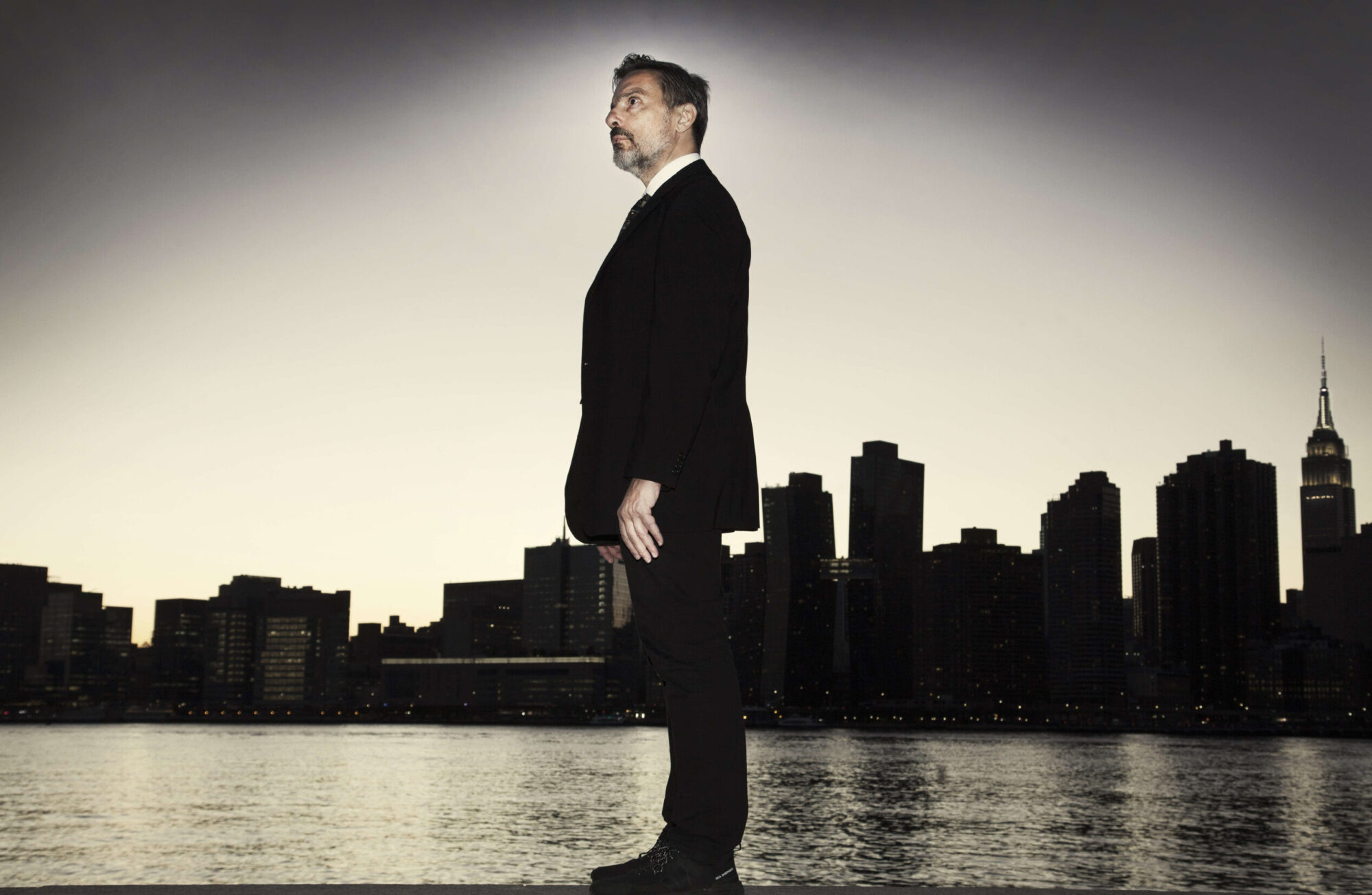
Type: Presentation Date: 5 May 2026 Context: II International Scientific and Practical Conference “Personality as a Space for Challenge and Formation of Culture” Location: Kyiv, Ukraine Institution / Organisation: National University of Physical Education and Sport of Ukraine (NUPESU) Role: Presenter Status: Conference Abstract / Public Record
Embodied Personality in the National Cultural Space This presentation examines how embodied personality functions as a national cultural space in which values, memories, and artistic genealogies are formed and transmitted. Drawing on my practice as a dance artist and oral historian, I consider how verbal historical records can emerge from non-logocentric, embodied processes, and how such approaches reveal relationships between subjectivity, social environments, and cultural memory.
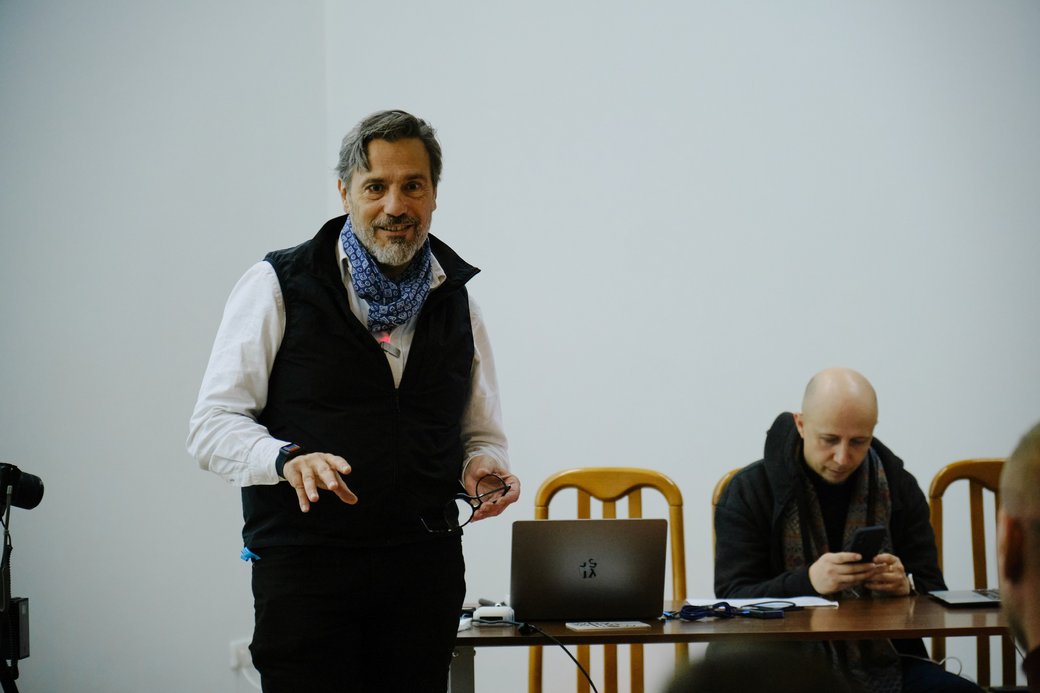
Ricardo Viviani and Viktor Ruban. Photo: Solomiia Kozolup / Suspilne Kultura
Type: Press Report · English Summary Date: 15 December 2025 Context:Oral History for Dance Heritage, National Art Museum of Ukraine (NAMU), Kyiv Author: Maria Kabatsii Publication:Suspilne Kultura Subject: Archiving Ukrainian Dance Heritage
Press Report: How NAMU Works on Archiving Ukrainian Dance
This page presents an English summary of a report by Maria Kabatsii, published by Suspilne Kultura. The journalist attended one day of the six-day intensive Oral History for Dance Heritage at the National Art Museum of Ukraine (NAMU) in Kyiv and its concluding round table. Her report documents how dance researchers, practitioners, museum workers and historians were working to develop approaches to preserving and archiving Ukrainian dance heritage. The report focuses particularly on the adaptation of Oral History to dance and on the institutional challenges involved in bringing an ephemeral art form into museum and archival practice.
The project, Oral History for Dance Heritage, was organized by the Impulse Transformation Platform with support from the Goethe-Institut in Ukraine and in partnership with NAMU. According to the report, Ricardo Viviani was invited as a lecturer and Oral History specialist from the Pina Bausch Foundation, and researchers from different Ukrainian cities worked together with museum specialists to adapt the method to the Ukrainian dance context.
Kabatsii’s report emphasizes the difficulty of documenting dance through conventional verbal or archival means. Viviani describes the challenge as creating ways to talk about dance and to help practitioners express the depth of their knowledge. The article places this question within a wider discussion of the relationship between embodied experience, memory and the documentation of dance.
The report also describes gaps in the documentation of Ukrainian dance. Historian Taras Samchuk points to dance as a comparatively neglected research field, while curator and project initiator Viktor Ruban discusses the loss of experimental dance histories that were not documented and therefore remained primarily in personal memories and private archives. The article connects these gaps with broader questions of cultural memory and identity in Ukraine.
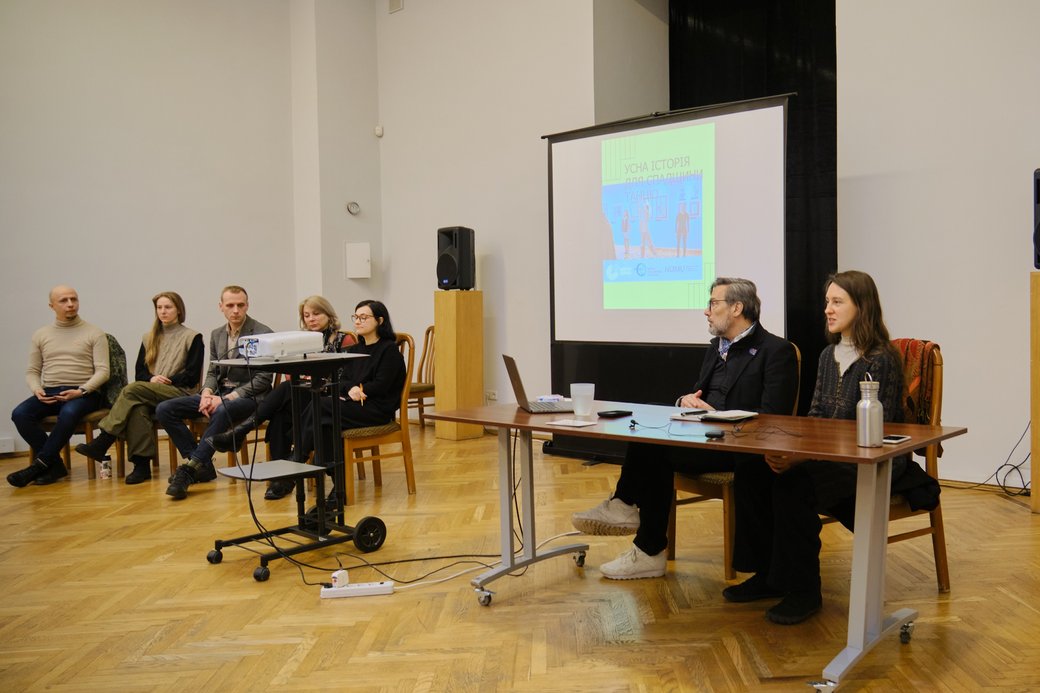
Final round table at NAMU. From left: Viktor Ruban, Khrystyna-Maria Slobodyaniuk, Taras Samchuk, Liudmyla Mova, Daryna Yakymova, Ricardo Viviani and Karina Soika. Photo: Solomiia Kozolup / Suspilne Kultura
The article places the workshop within NAMU’s recent efforts to make dance visible as an artistic medium in its own right. It refers to the museum’s earlier project “Dance in the War Zone?”, which brought contemporary dance into the museum and established a basis for subsequent collaboration between the institution and dance researchers.
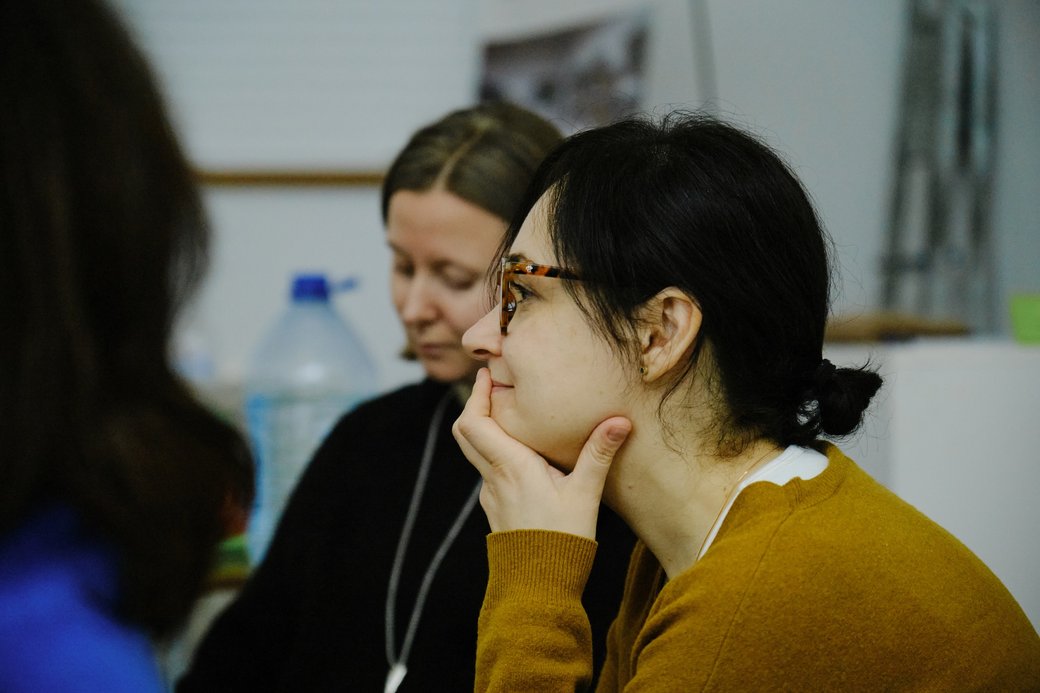
Daryna Yakymova. Photo: Flora Borovyk / Suspilne Kultura
A central point in the report is the development of museum approaches for preserving dance. Daryna Yakymova explains that NAMU intends to develop storage protocols for an ephemeral art form and identifies Oral History as a method that could help document and archive this heritage. She also describes the lack of specialists with specific knowledge of dance history, terminology and archival requirements within museum institutions.
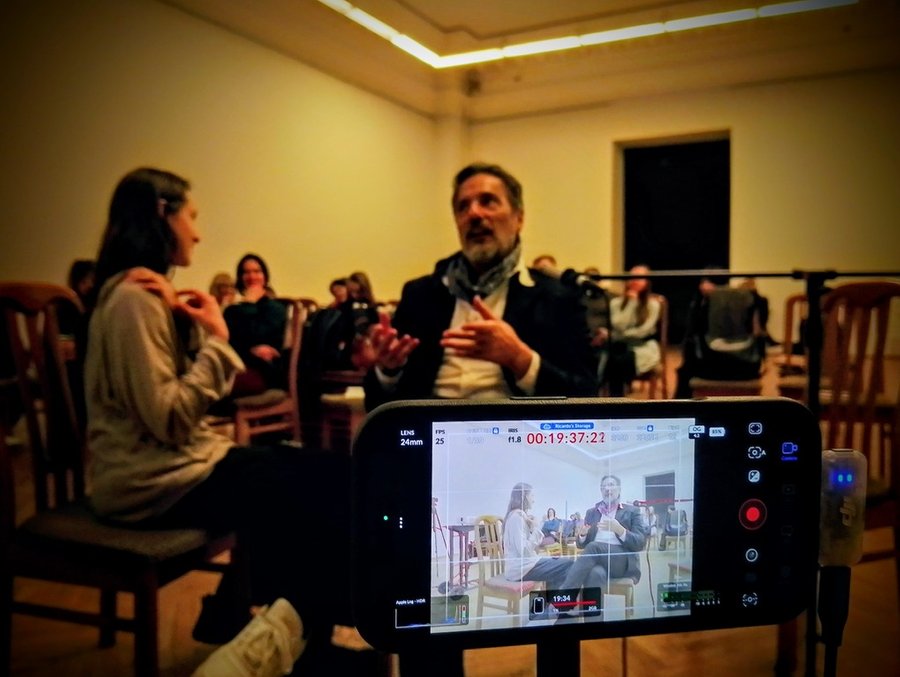
Interview recording training with Ricardo Viviani. Photo: Flora Borovyk / Suspilne Kultura
The report also documents practical interview training during the workshop. Alongside the methodological discussion, participants considered the practical conditions of recording and preserving oral histories and the institutional resources required to maintain a digital archive. Viviani identifies institutional support and digital infrastructure as significant challenges and stresses the need to distinguish the documentation of dance history from the process of creating dance itself.
The article concludes by connecting the preservation of Ukrainian dance with cultural memory and identity. It presents the attempt to archive dance as relevant not only within Ukraine but also internationally, because documenting Ukrainian dance can make histories and practices that remain insufficiently known accessible to wider audiences.
Archival Material:
Press article; press photographs; workshop documentation; interview-training documentation; related project material concerning Oral History for Dance Heritage and the archiving of Ukrainian dance.
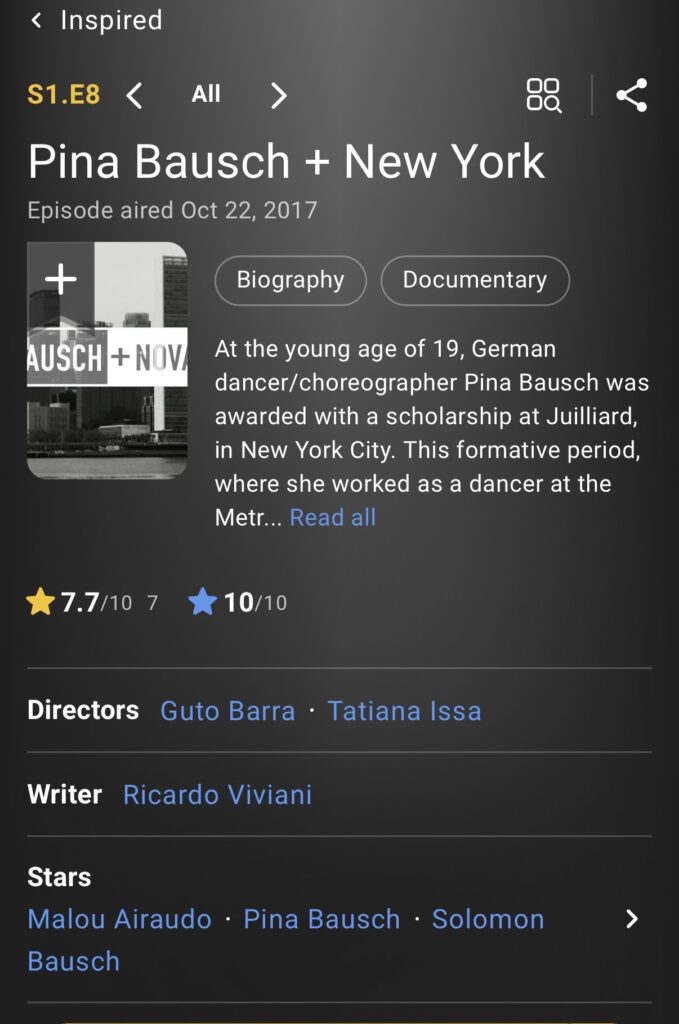
Type: Publication · Documentary Film · Oral History Date: 2017 Context:Pina Bausch + New York, part of the series Geografia da Arte Role: Script Writer · Researcher Production: Producing Partners NYC in collaboration with the Pina Bausch Foundation Broadcast: Arte1, Brazil Locations: New York · Chicago · Woodstock · Wuppertal · Essen
Pina Bausch + New York explored the formative relationship between Pina Bausch and New York through archival research, Oral History and conversations with artists and people connected to her experiences in the United States.
The project was Ricardo Viviani’s first major project at the Pina Bausch Foundation after joining the institution in 2016. It brought together his new role as a researcher at the Foundation with experiences from his own history as a dancer and choreographer in the New York dance environment.
Viviani had first met Pina Bausch personally in New York after performances of Viktor at the Brooklyn Academy of Music. Bausch stayed with dancer Manuel Alum at his loft in TriBeCa, together with her son. Viviani was part of Alum’s performing circle and had known him since his own years at Jacob’s Pillow.
This encounter revealed connections between Viviani’s own formation in the New York dance scene and Bausch’s formative experiences in the United States. When the documentary research began, these intersections became a starting point for tracing the people, places, teachers and artistic encounters connected to Bausch’s early development.
Research
The research extended across a wide range of dance and performing-arts archives and personal networks. Viviani worked with the archives of the Pina Bausch Foundation and the Deutsches Tanzarchiv Köln, as well as collections and institutions in the United States including the 92nd Street Y, Jacob’s Pillow, the New York Public Library’s Dance Collection and the archives of Juilliard School.
At the 92nd Street Y, where Pina Bausch had danced in New York for the first time, Viviani encountered an institution that was also part of his own history as a choreographer, having received a grant and presented work there. At Jacob’s Pillow, he returned to an archive and community he had known since 1980, when he was a scholarship student there, and worked with longtime archivist and curator Norton Owen.
The research also included conversations with dance scholars and critics including Mark Franko and Deborah Jowitt, as well as tracing places, people and artistic networks connected to New York in the late 1950s and early 1960s. Viviani also drew on his own study with Alfredo Corvino and his knowledge of the New York dance environment.
Oral History
The documentary developed an Oral History-based account of Pina Bausch’s formative relationship with New York. Interviews and archival research brought together memories of artists, teachers, collaborators and other witnesses, allowing aspects of Bausch’s early artistic development to be reconstructed through personal testimony and historical sources.
The resulting material provides a record of experiences and encounters that are not always visible in conventional accounts of Bausch’s biography, including the teachers, artistic communities and cultural environments that she encountered in New York and the United States.
Production
The opportunity to produce the interviews arose through an independent coincidence. Rolf Salomon Bausch received a request to collaborate with a New York production company developing a series about artists and geographical places. This led to a collaboration between Producing Partners NYC and the Pina Bausch Foundation.
Interviews and filming subsequently took place in Chicago, New York, Woodstock, Wuppertal and Essen. Although the production company was based in New York, the resulting series was produced for the Brazilian cable channel Arte1.
Producing Partners, led by Tatiana Issa and Guto Barra, was responsible for the production on the New York side.
Archival Material:
Film and production documentation; research notes; Oral History interviews; archival research material; correspondence and production material where preserved; related documentation concerning Pina Bausch’s relationship with New York.