„Ein Kind, dem nie Märchen erzählt worden sind, wird ein Stück Feld in seinem Gemüt behalten, das in späteren Jahren nicht mehr angebautwerden kann.“ Johann Gottfried von Herder, Schriftsteller, Philosoph und Theologe der Aufklärungszeit
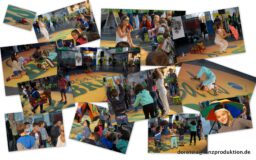
Unermüdlich erzählen wir deshalb auf der Bühne Märchen – immer in der Verantwortung, dass tausende Kinder zum allerersten Mal den Theaterraum betreten und mit allen Sinnen dem Bühenerlebnis entgegenfiebern.
In diesem Jahr präsentieren wir ein Märchen, das zu den meist erzählten gehört – aber auch zu den meist umstrittenen: Eltern bringen aus sozialer Not ihre beiden Kinder tief in den Wald und hoffen, dass Hänsel und Gretel dort verloren gehen.
Auf ihrem Irrweg gelangen die ausgestoßenen Kinder an das Lebkuchenhaus einer Menschen fressenden Hexe. Mit List können sich beide befreien und kehren mit reichlich Schmuck und Nahrung zurück zum Elternhaus.
Entgegen der Haltung der 70er Jahre, die das Erzählen der Volksmärchen in Frage stellte, werden wir uns gemeinsam mit den jungen Gästen hinein stürzen in diese Geschichte über böse und gut, dumm und schlau, traurig und lustig, hungrig und satt, dunkel und hell, unglücklich und glücklich.
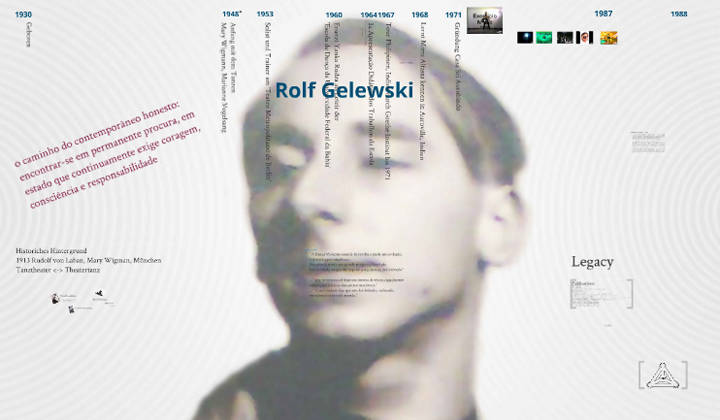
Rolf Gelewski — Ricardo Viviani presentation, 11 May 2015
Type: Presentation · Research Date: 11 May 2015 Context: Research into Rolf Gelewski and dance pedagogy Format: Prezi presentation Role: Researcher · Presenter Subject: Rolf Gelewski (1930–1988)
Rolf Gelewski — A Biographical Presentation
On 11 May 2015, Ricardo Viviani prepared a Prezi presentation devoted to the life and work of Rolf Gelewski. The presentation formed part of his research into Gelewski’s place within dance pedagogy and his relevance to Viviani’s own artistic formation.
The presentation is preserved as a record of the research activity itself. The Prezi remains the principal document.
Archival Material:
Prezi presentation dated 11 May 2015; presentation images; research notes; related references to Gelewski.
Type: Production · Presentation · Dance Education Date: 12 June 2014 — documented premiere Time-span: 2014 Location: Casa do Brasil · Frankfurt Hauptbahnhof, Frankfurt am Main, Germany Context: Brazilian Carnival · cultural education · young audiences · 2014 FIFA World Cup Role: Choreographer · Director · Dance Educator Participants: Julia Mota Carvalho — Dorotéia · dance dramaturgy Status: Historical record · documented from surviving project material
Record / Description
Carnaval da Dorotéia — Tanzen mit Dorothee was a dance-education and cultural presentation for children introducing Brazilian Carnival through movement, music and regional cultural references.
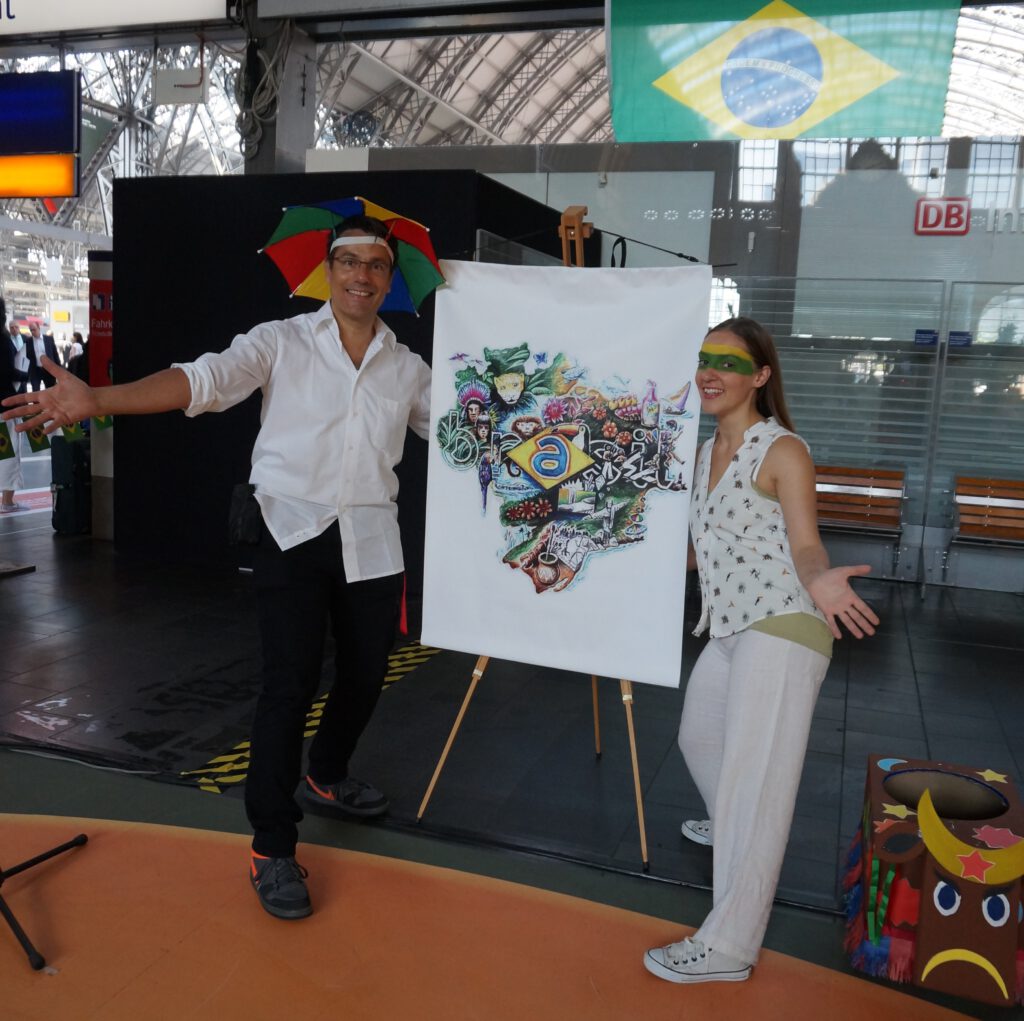
Ricardo Viviani and Júlia Carvalho for Carnaval da Dorotéia at the Frankfurt Hauptbahnhof
The surviving project exposition documents the premiere at Casa do Brasil, Frankfurt Hauptbahnhof, on 12 June 2014. The project was conceived for children and their parents and combined an introduction to Brazilian Carnival with practical dance and movement activities.
The surviving material describes Brazilian Carnival through examples from different regions of the country. The programme connected the activities to the atmosphere surrounding the 2014 FIFA World Cup in Brazil and referred specifically to Salvador, Fortaleza and Recife and to forms of Carnival and popular dance associated with those places.
The project was conceived not simply as a performance but as an encounter in which children could experience Brazilian culture through their own bodies, music and movement.
The Work / Creation
Carnaval da Dorotéia, Frankfurt Hauptbahnhof, 2014. Public web version reduced in resolution for privacy protection; original photograph
The project exposition identifies Ricardo Viviani as choreographer and describes the format as a one-hour pedagogical encounter with three principal stages:
Introduction — approximately 15 minutes. Dorotéia welcomes the children, introduces Brazilian Carnival, plays music and demonstrates dance movements. A playful geographical association connects Brazilian regions and cities with different Carnival traditions.
Dance and movement — approximately 30–40 minutes. The children participate in free movement, coordination and rhythm exercises, spatial work and basic dance movements. A simple choreographic structure develops into a more open and festive Carnival section.
Reflection. The concluding section combines photographs, movement and conversation about Brazil, Carnival and the places introduced during the activity. The surviving exposition refers specifically to a Bumba-meu-boi element in this concluding context.
Production
The surviving production documentation credits Ricardo Viviani with concept, choreography and pedagogical execution. The project also identifies Julia Mota Carvalho as Dorotéia and as a dance dramaturgical collaborator.
Ricardo’s archival recollection describes the project as a commissioned intervention connected with the Brazilian cultural programme in Frankfurt during the 2014 World Cup. The precise commissioning organisation is not named here because it has not yet been independently established from the surviving documentation.
Contracts, invoices and other managerial or administrative documents relating to the production are preserved privately and are not reproduced on this public archival page.
Dance Education
Carnaval da Dorotéia continues a documented strand of Ricardo Viviani’s practice connecting professional dance, cultural education and work with young audiences.
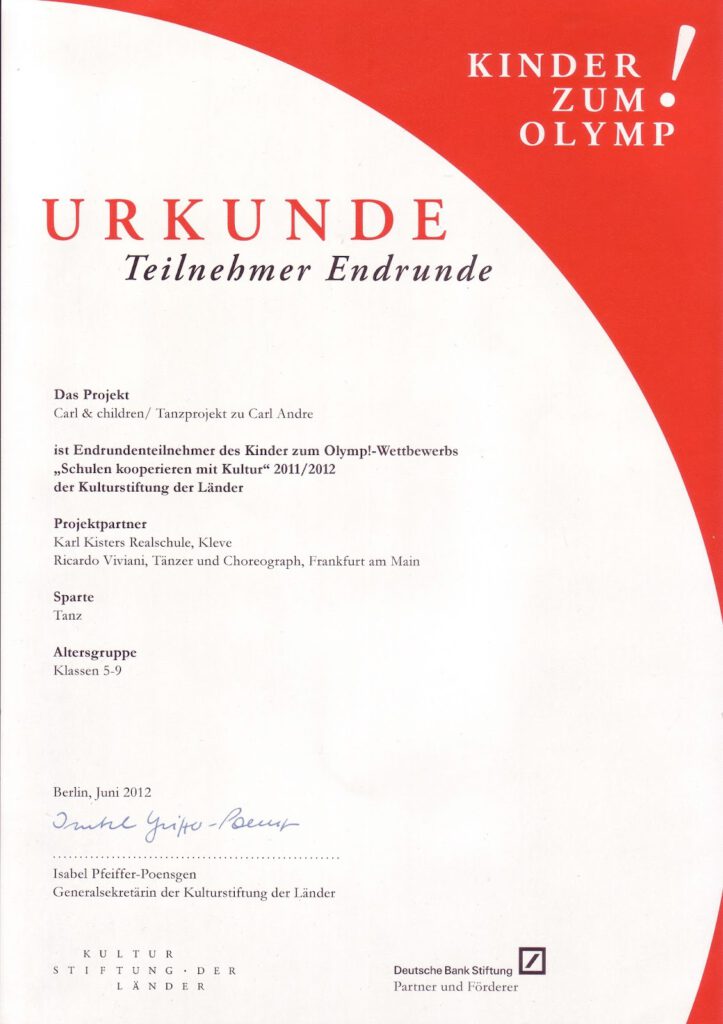
An earlier documented example is Carl & children / Tanzprojekt zu Carl Andre, developed with the Karl Kisters Realschule in Kleve. The surviving Kinder zum Olymp! certificate identifies the project as an Endrundenteilnehmer of the 2011/2012 competition „Schulen kooperieren mit Kultur“, in the category Tanz for Klassen 5–9, with Ricardo Viviani identified as Tänzer und Choreograph.
This Kleve work is independently corroborated by the NRW Kultur und Schule project documentation, which records Ricardo Viviani as the artist for Klever Klangnacht at Karl Kisters Realschule Kleve-Kellen during the 2011/2012 school year. Museum Kurhaus Kleve also documents the Karl Kisters Realschule’s participation in the Schule Kunst Museum network and student dance performances connected with the Carl Andre exhibition.
The Kleve work is retained here as relevant background to Viviani’s established practice with schools, dance education and young people. A fuller archival account of the Karl Kisters Realschule, Kleve and Museum Kurhaus collaborations will be documented separately.
Kinder zum Olymp! certificate documenting Carl & children / Tanzprojekt zu Carl Andre as an Endrundenteilnehmer, 2011/2012.
Activity / Event
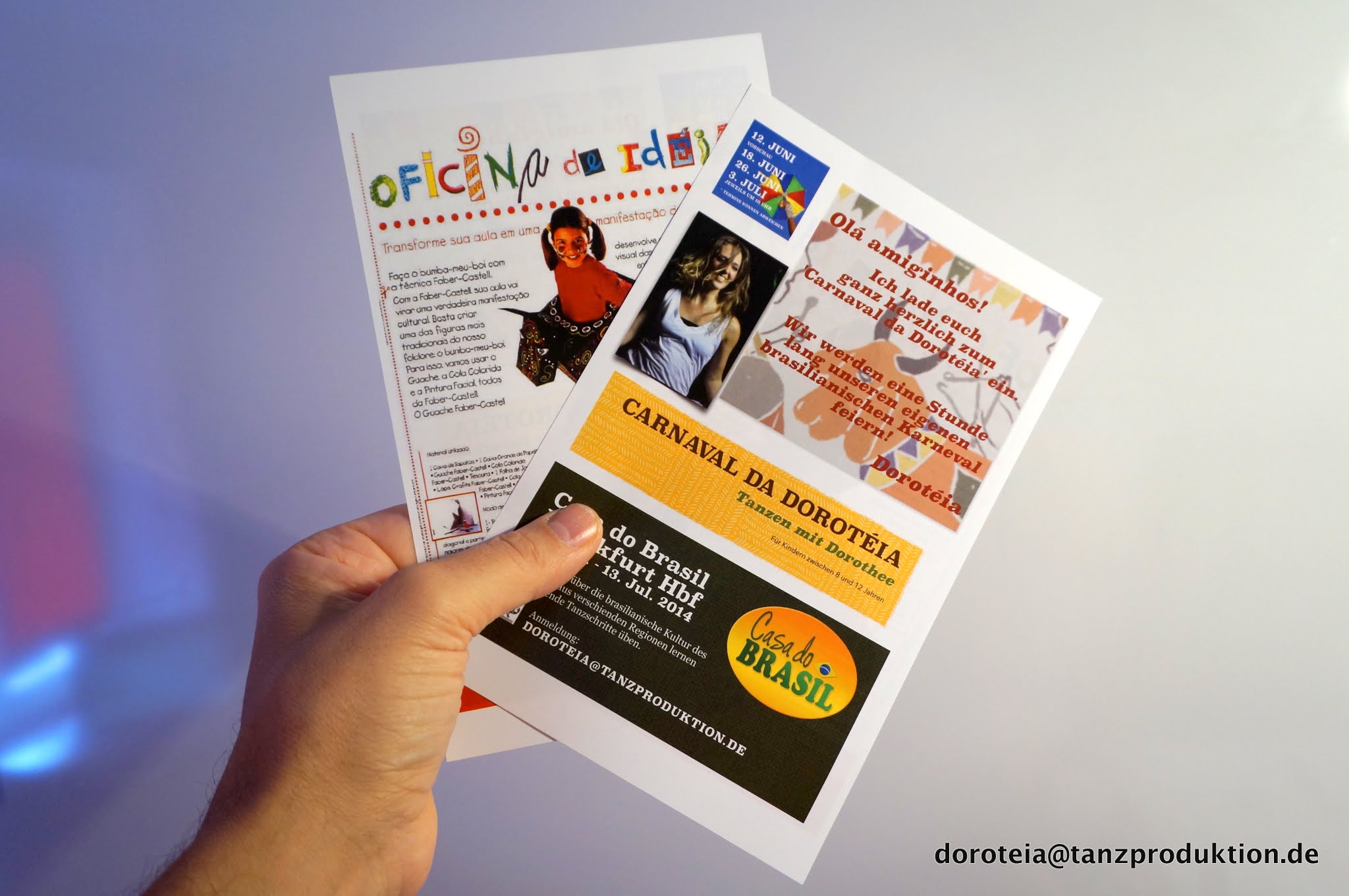
The surviving flyer documents a public presentation at Casa do Brasil, Frankfurt Hauptbahnhof, with the date 13 July 2014. The project exposition, however, identifies 12 June 2014 as the premiere. The two dates are therefore preserved as separate documentary references rather than reconciled by assumption.
The flyer also gives a different target age range from the project exposition: it addresses children aged 8–12, while the exposition describes the project as intended for children aged 5–12. Both formulations are retained as evidence from their respective documents.
Promotional flyer for Carnaval da Dorotéia at Casa do Brasil, Frankfurt Hauptbahnhof, 2014.
Primary Source / Documentation
The principal surviving documentation consists of the project exposition Carnaval da Dorotéia — Tanzen mit Dorothee, version 3, dated 15 January 2015; the promotional flyer; surviving photographs; the promotional video; and associated project records.
The exposition provides the principal documentary account of the project’s concept, pedagogical structure, team and intended audience. The flyer provides independent documentary evidence for a public presentation and preserves a different date and age specification.
The surviving visual material is retained as archival evidence. Where children appear, public derivatives should be reduced, cropped or otherwise prepared so that children are not reasonably identifiable. Original documentary files remain preserved separately as archival masters.
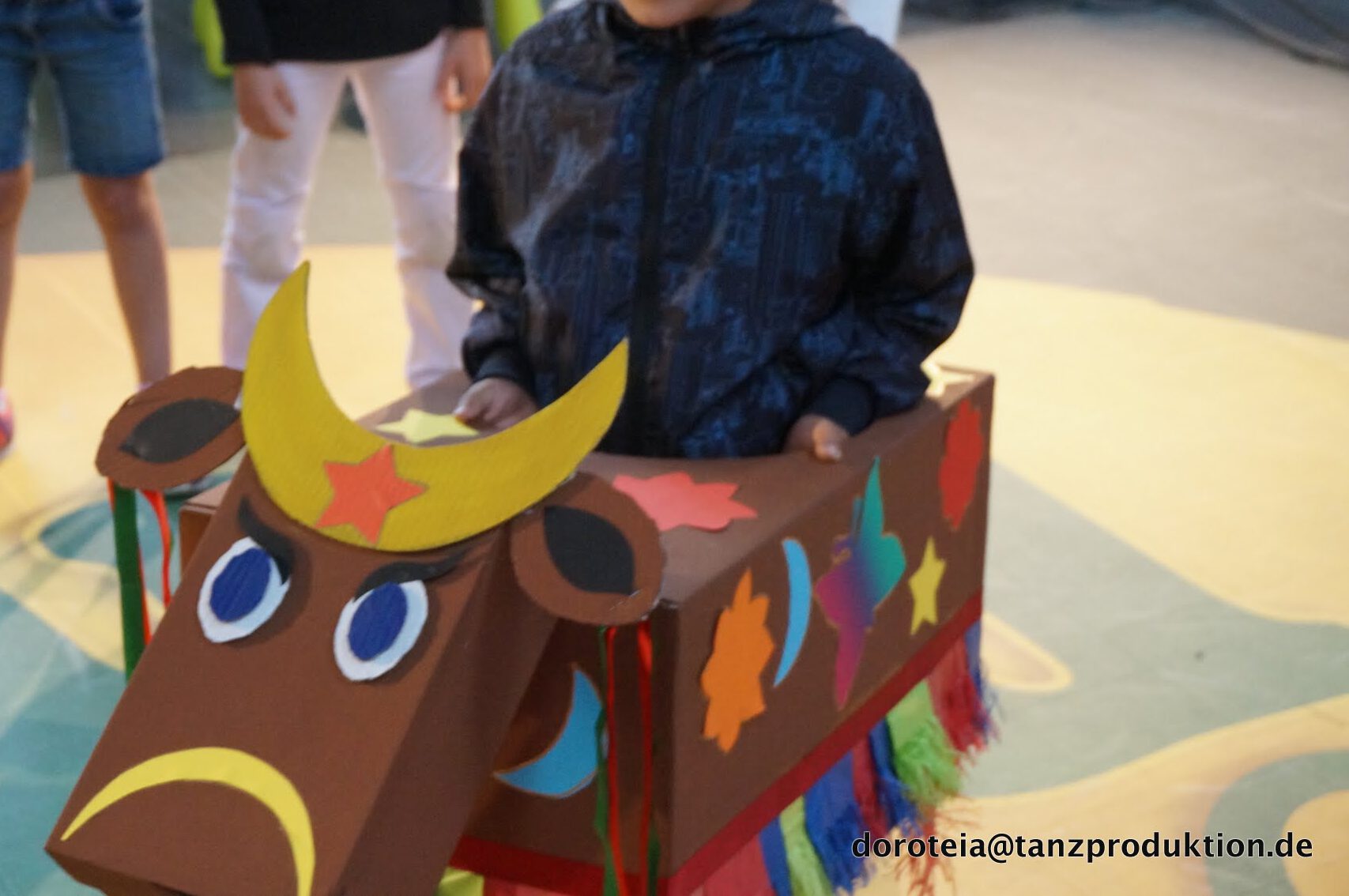
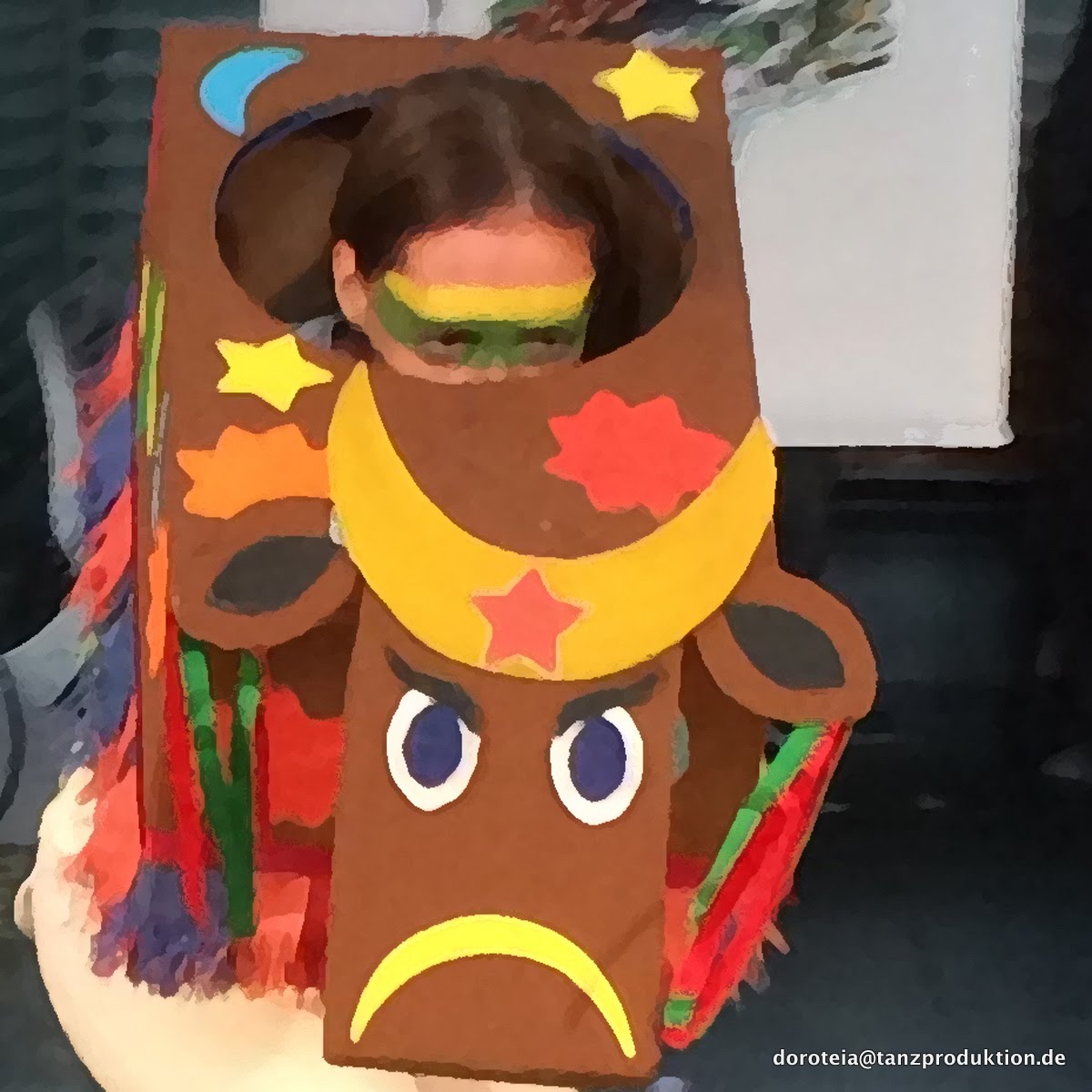
Bumba-meu-boi element associated with the Carnaval da Dorotéia activity.
Personal Reflection
I later collaborated with Júlia in a commission during the football World Cup in Brazil to create an occupation in the Frankfurt train station in Germany to present Brazil through its different Carnival cultures and give the continental dimension of the country. It was called Carnaval da Dorotéia for young people and schools. Many pictures survive and a flyer describing the intervention to recruit school classes. [from IRIBIRI recollections]
This recollection is preserved as Ricardo Viviani’s retrospective account and is distinguished from the independent documentary evidence contained in the surviving project material.
Relationship
Carnaval da Dorotéia is related to Ricardo Viviani’s broader work in dance education and with young audiences, including documented projects developed with schools in Kleve. The relationship to the Karl Kisters Realschule and the Museum Kurhaus Kleve will be developed more fully in the relevant archival records rather than duplicated here.
Place / Context
Carnaval da Dorotéia, Frankfurt Hauptbahnhof, 2014. Public web version reduced in resolution for privacy protection; original photograph preserved in the archive.
Casa do Brasil, Frankfurt Hauptbahnhof formed the documented institutional and spatial setting for the project. The Frankfurt Hauptbahnhof context was particularly relevant to the project’s public-facing cultural approach: Brazilian Carnival was presented in a major railway environment during the period of the 2014 World Cup.
The surviving project documentation should be read primarily as evidence of a cultural-educational intervention rather than as a conventional stage production.
Contribution / Significance
The project is significant within Ricardo Viviani’s practice because it brought together choreography, dance education, cultural mediation and young audiences in a public setting.
Its distinctive contribution was to approach Brazilian Carnival through embodied experience: children encountered regional cultural references through music, rhythm, movement and participation rather than through information alone.
Assessment / Relevance
Carnaval da Dorotéia documents an intersection between Viviani’s Brazilian cultural background, his professional choreographic practice and his continuing work in dance education.
The surviving documentation also demonstrates a form of cultural presentation in which dance functions simultaneously as artistic practice, educational medium and means of intercultural encounter.
Archival Material
Surviving material includes: Project exposition: Carnaval da Dorotéia — Tanzen mit Dorothee, version 3, 15 January 2015, Promotional flyer for Casa do Brasil, Frankfurt Hauptbahnhof, Photographic documentation from 2014, Promotional video, Private contracts, invoices and administrative project records, retained but not reproduced publicly.
Keywords
Carnaval da Dorotéia · Tanzen mit Dorothee · Brazilian Carnival · dance education · Dance Educator · young audiences · children · cultural education · Frankfurt · Frankfurt Hauptbahnhof · Casa do Brasil · 2014 FIFA World Cup · Brazilian culture · Bumba-meu-boi · Frevo · Salvador · Fortaleza · Recife · Julia Mota Carvalho · Ricardo Viviani
This record distinguishes documentary evidence, external documentation and Ricardo Viviani’s retrospective recollection. Dates, audience descriptions and other details are retained according to their respective surviving sources where discrepancies occur. Later discoveries, corrections or additional documentation should be added through a dated Post Scriptum rather than silently altering the historical record.
This record documents a period of collaboration in Kleve connecting dance, museums, schools and cultural education. From 2009 onward, Ricardo Viviani worked with schools and cultural institutions in Kleve, bringing dance and choreographic practice into encounters with visual art and museum exhibitions.
The surviving documentation shows a form of artistic education in which dance was not simply an additional activity for young people. Movement, spatial perception, bodily experience and choreographic practice became ways of encountering, interpreting and responding to artworks.
The collaboration developed principally through the network connecting Museum Kurhaus Kleve, participating schools including Karl Kisters Realschule, and the NRW state programme Kultur und Schule.
Museum and Education
The Museum Kurhaus Kleve’s documentation of Schule Kunst Museum records a year-long collaboration between the museum and five Kleve secondary schools. In 2009, students worked with exhibitions including Ettore Spalletti and with works by Stephan Balkenhol and Ewald Mataré from the museum collection. Their responses included visual and performing arts, photography, video and dance performances.
The museum identifies Ricardo Viviani as the international choreographer and dancer who worked with the students through funding from the NRW state programme Kultur und Schule. The students were not only recipients of art education but became artistic participants, presenting their own works and performances within the museum.
This institutional documentation establishes the central character of the Kleve collaboration: dance entered the museum-school relationship as an artistic practice and as a way of engaging with visual art.
Dance in the Museum
The Kleve projects explored the possibility of approaching visual art through bodily and spatial experience. Dance provided another form of attention to artworks: through movement, students could investigate space, scale, relation, perception and physical response rather than relying exclusively on verbal explanation.
This approach became particularly explicit in the later Carl & children / Tanzprojekt zu Carl Andre project. The surviving project documentation describes students engaging with Carl Andre’s sculptures through bodily and spatial perception, developing movement and choreographic responses to the works.
In this context, dance functioned simultaneously as artistic practice, a method of observation and a form of learning.
Pedagogical Development
The collaboration with Kultur und Schule also formed part of Ricardo Viviani’s own continuing development as an educator. His pedagogical studies and professional development include work with Christa Coogan and continuing-education activities associated with the NRW programme Kultur und Schule, with Anja Weber, Maria Speth and Nadja Raszewski.
His studies also included the Landesmusikakademie NRW — Pädagogisches Basisseminar I und II, with van Almsick, Schneider, Levkau and Jendrkowiak. These experiences form part of the pedagogical background to his later work connecting dance, embodied learning, cultural education and artistic practice.
The inclusion of this training is significant because the Kleve collaboration was not only a transfer of existing dance knowledge into a school and museum environment. It also involved an ongoing development of the pedagogical methods through which that knowledge could be shared.
Projects and Activities
2009 — Schule Kunst Museum / Museum Kurhaus Kleve
Students from several Kleve secondary schools worked with exhibitions at Museum Kurhaus Kleve and developed their own artistic responses. The museum’s documentation records dance performances among the resulting works and identifies Ricardo Viviani as the choreographer and dancer supporting the students through Kultur und Schule.
2010 — Workshop on the Works of Ewald Mataré
A further workshop connected dance and the encounter with visual art. Contemporary documentation is preserved in the Tanzen macht Schlau! archive.
2011/2012 — Carl & children / Tanzprojekt zu Carl Andre
A dance and education project developed with students in relation to the work of Carl Andre. The surviving documentation presents bodily perception, spatial experience, somatic thinking and movement as ways of engaging with sculpture.
The project was documented as an Endrundenteilnehmer in the 2011/2012 Kinder zum Olymp! competition. The surviving certificate identifies Karl Kisters Realschule, Kleve, and Ricardo Viviani as project partners.
2011/2012 — Klever Klangnacht / Karl Kisters Realschule
The NRW Kultur und Schule documentation records Ricardo Viviani as the artist working with Karl Kisters Realschule Kleve-Kellen in the 2011/2012 school year. The project is described as interdisciplinary and identifies body movement and dance as artistic and emotional forms of expression. It involved approximately 20 students and continued throughout the school year as a continuous measure.
Contribution / Significance
The Kleve collaborations form an important strand in Ricardo Viviani’s development of dance as a medium of cultural education. Their significance lies in the movement between institutions and forms of knowledge: museum and school, visual art and dance, observation and bodily experience, artwork and student response.
The work demonstrates an approach in which dance can enter the museum not merely as performance, but as a method for encountering and interpreting art.
The Carl & children project represents a documented culmination of this strand. Its selection as an Endrundenteilnehmer in the 2011/2012 Kinder zum Olymp! competition provides recognition of the school–artist collaboration, while the surviving project documentation preserves the particular role of dance and embodied learning within it.
Primary Documentation
Tanzen macht Schlau! remains the principal surviving contemporary documentation for this strand of work. The blog records projects and activities in Kleve from 2009 onward, including workshops connected with Ettore Spalletti, Ewald Mataré and Carl Andre.
The public presentation of this historical documentation is currently being reviewed with regard to privacy and data minimisation, particularly where historical photographs may contain identifiable children. The archival value of the surviving documentation is preserved while its public presentation is being reassessed.
Archival Material
Surviving material includes project documentation, photographs, flyers, school and museum references, the Tanzen macht Schlau! blog archive, and the Kinder zum Olymp! certificate documenting Carl & children / Tanzprojekt zu Carl Andre as an Endrundenteilnehmer in 2011/2012.
Archival Status: Historical Record — incomplete / ongoing archival reconstruction.
This page is an umbrella record for Ricardo Viviani’s documented collaborations in Kleve involving dance, museums, schools and cultural education. It does not replace individual archival records or the contemporary documentation of the projects themselves.
External institutional sources are used where they independently document the collaboration. The Kinder zum Olymp! Endrunde status is documented by the surviving certificate held in the archive.
The Tanzen macht Schlau! blog is retained as an important contemporary source, while its public presentation is subject to ongoing privacy and GDPR review.
Die Prinzessin auf der Erbse – das Märchen zur Weihnachtszeit am theaterhagen
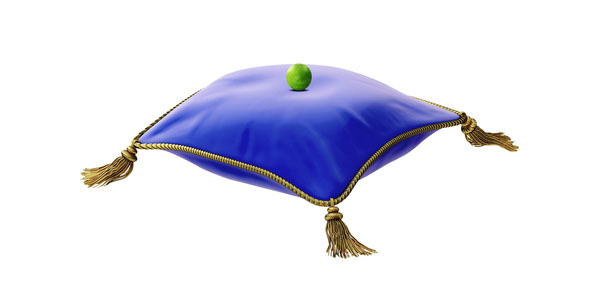
Prinz Malte Nils Finn Jannik Søren Jasper soll heiraten. Aber er darf nicht entscheiden, wen! Denn seine Eltern haben genaue Vorstellungen von der zukünftigen Schwiegertochter: Aus einem reichen Königshaus soll sie stammen, sittsam, schweigsam und empfindsam muss sie sein. Aber was ist, wenn der Prinz keine Lust auf‘s Heiraten hat? Schon gar nicht eine unbekannte Königstochter.
Im nahe gelegenen Wald begegnet er Jette. Stark ist sie, klug und selbstständig, ganz anders als alle Mädchen, die er je gesehen hat. Ein bisschen erschreckt sie ihn, denn sie schläft auf dem Boden, lebt alleine, ist ziemlich dreckig und riecht fremd. Trotzdem bringt sie sein Herz zum Rasen. Plötzlich will der Prinz ganz schnell heiraten, nämlich Jette! Aber so einfach geht das nicht. Im Schloss muss Jette erst noch die große Prüfung der Königin bestehen. Doch 20 Matratzen, eine winzige Erbse und ein gut gehütetes Geheimnis des Haushofmeisters Andersen führen schließlich zu einem glücklichen Ende.
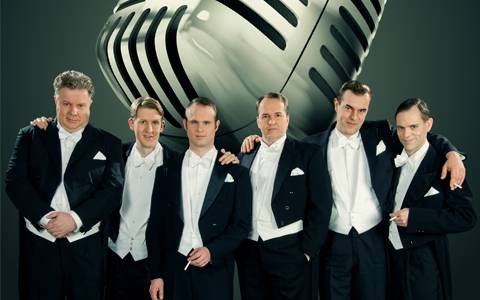
Diese Anzeige hatte Harry Frommermann im Dezember 1927 aufgegeben, um ein Gesangensemble wie die amerikanischen „Revelers“ zu gründen. Darauf hatten sich rund 70 Männer gemeldet – Arbeitslose, verkrachte Existenzen, Kranke, Krüppel, doch keiner von ihnen konnte singen, bis auf den letzten, der im Chor des Großen Schauspielhauses engagiert war.
„Achtung, Selten! Tenor, Bass (Berufssänger nicht über 24), sehr musikalisch, schön klingende Stimmen, für einzig dastehendes Ensemble unter Angabe der täglich verfügbaren Zeit gesucht.“